


A Moment of Silence
Depicted over the gallery doors of the House Chamber in the U.S. Capitol are 23 historical figures noted for their work in establishing the principles that underlie American law. Moses, is in the center, facing forward, with 11 portraits on either side facing right and left toward him. Of course, this is in recognition of the fact that the foundations of a moral and ethical society must be predicated on a belief in G-d as transmitted to Moses, the Jewish people and, by extension, the whole world at Mount Sinai.

An Objective Truth
Elie Wiesel, an author, Nobel Prize laureate, and renowned Holocaust survivor, once recounted his visit to Brooklyn in the early '60s to meet with the Rebbe, M.M. Schneerson.
Wiesel posed a poignant question to the Rebbe, asking, "How can you believe in G-d after Auschwitz?" The Rebbe responded by looking at him in silence, his hands resting on the table. After a moment, he shed a tear and softly replied, "In whom do you expect me to believe after Auschwitz? In man?"

The First Request of a Freed Hostage
After 491 days in Hamas captivity, Eli Sharabi was released this weekend in a terribly weakened and emaciated state, to the devastating news that his wife and daughters were murdered in the October 7 attacks.
One of his first requests was a spiritual one—a pair of tefillin—and his family's Chabad rabbi was ready to help.
The Surprising Key to Combating Anti-Semitism
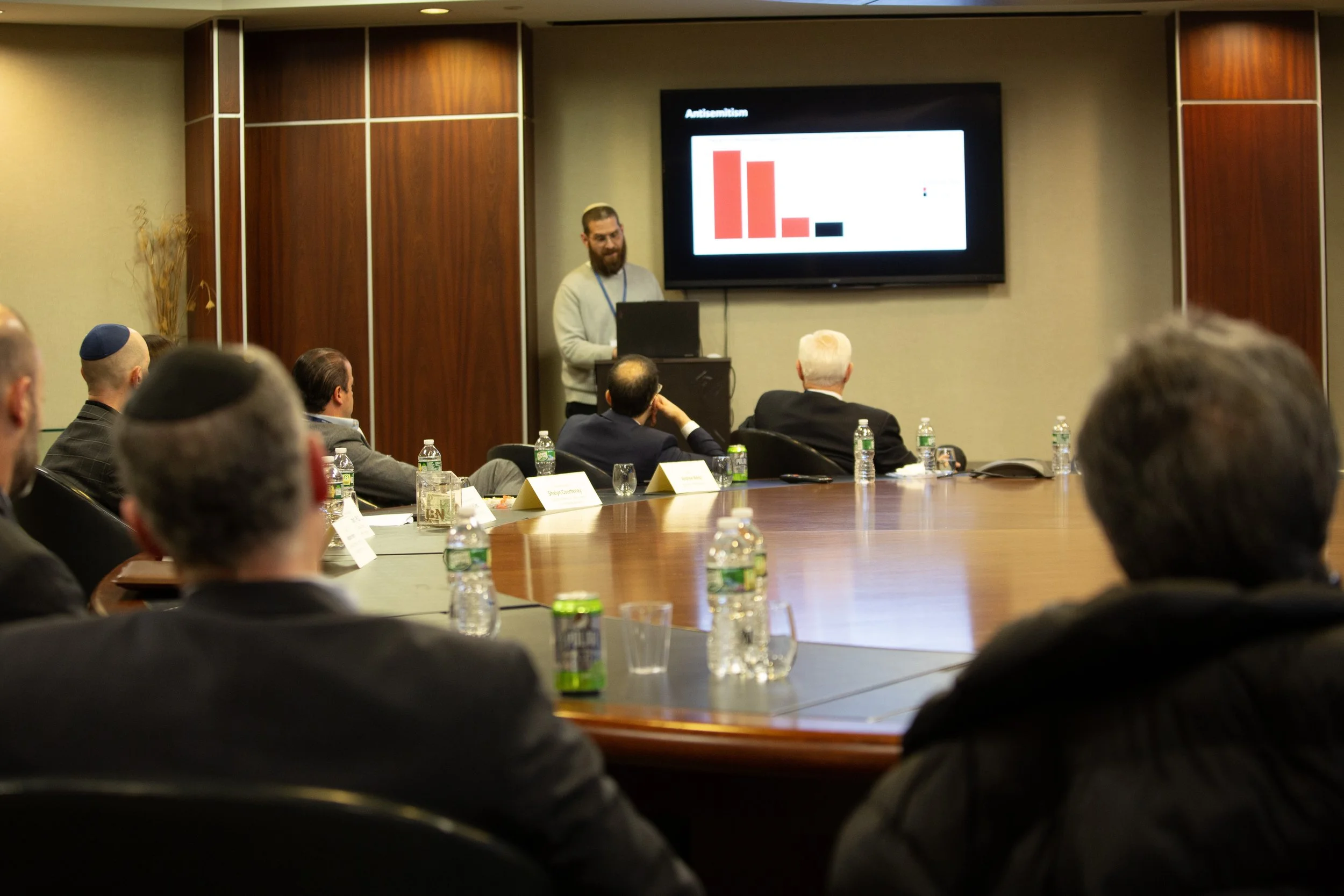
At a recent JBN Executive Roundtable, we had the privilege of hosting Dr. Joel Finkelstein, Ph.D., Chief Science Officer and co-founder of the Network Contagion Research Institute (NCRI). Dr. Finkelstein’s work pioneers new methods in the cyber social sciences to confront some of the most serious threats of the information age. His research offers a clarifying lens on how antisemitism, hate, and extremism spread; why many well-intended efforts to combat them are failing; and what actually works instead.

Proactive Versus Reactive
When news spread of the disturbing acts of anti-Semitic vandalism that took place at Jewish-owned shops in the Golden Horseshoe Shopping Center in Westchester on January 25, 2024, the Jewish community was rightfully shaken, disturbed, and indignant in the face of these shocking events.

Just Do It
“Just Do It” is not only a clever Nike marketing slogan, it's a way of life.
We may find ourselves at times inspired to launch a new business, take on a new project, spend more time with our family, or reconnect more with our Jewish identity. However, after the initial excitement wears off, it may become challenging to keep focused on attaining our goals.

Light Your Candle of Truth
On September 23, 2011, Prime Minister Benjamin Netanyahu delivered a powerful speech at the United Nations General Assembly. During his address, he recalled a conversation he had with the Rebbe in 1984. Netanyahu shared the Rebbe’s words when he became Israel's ambassador to the UN:
"Remember, you are going to the UN. You will be serving in a house of many lies. But remember, that even in the darkest place, the smallest candle can be seen far and wide. Your mission is to light a candle for truth and the Jewish people."
The Game Plan
When an individual, business, organization or community is faced with a challenge, there are often a variety of ways to respond to the issue. One group may easily give up when the problem seems insurmountable. A second group may choose to compromise their values and quality in order to avoid a greater potential loss. A third group may try to aggressively oppose and resist the challenge. And yet a fourth group may passively sit back and hope things will work out on its own.
The Future is Bright
Bar Kuperstein was a medic who was kidnapped by Hamas after staying behind at the Nova Festival to care for the wounded.
Years earlier, Bar had already assumed enormous responsibility. After his father, Tal—a fellow paramedic—was paralyzed in a car accident, Bar became the primary breadwinner for his family.
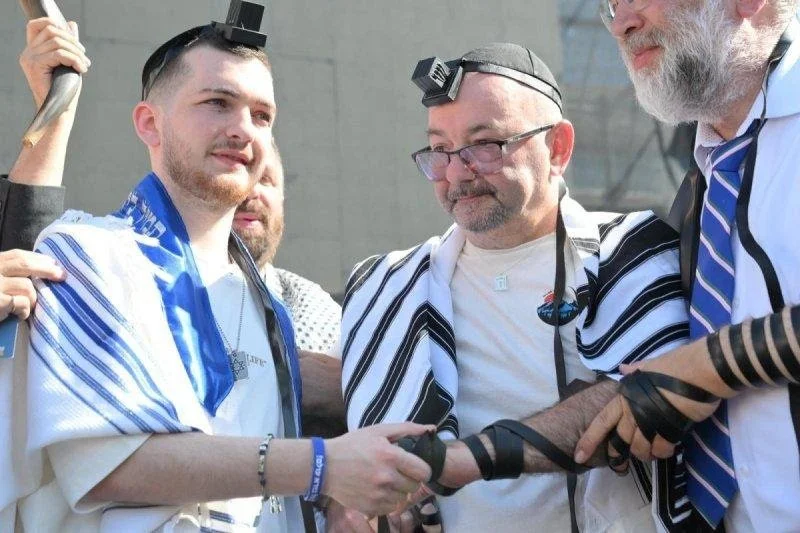
In the aftermath of Bar’s abduction, his mother, Julie Kuperstein, launched an extraordinary and deeply personal initiative. Rather than turning to politics or media campaigns, she asked Jewish men around the world to don Bar’s tefillin—and the tefillin of other captive men—in their merit.

It's a Beautiful World
On the evening of January 17th, 1951- 10th Shevat, 5711, a diverse crowd of a few hundred people which included holocaust survivors, refugees from Stalinist Russia and American-born young students, all gathered at the headquarters of the Chabad Lubavitch movement, 770 Eastern Parkway, Brooklyn, NY, in anticipation of a monumental event that was about to occur.

Song of the Soul
In a moving video clip from early October, a young man named Yehuda Becher can be seen singing a soul-stirring song he composed to the prayer “My G-d, the soul that You have placed before me, it is pure.” Tragically, just a few days later, Yehuda was murdered by terrorists at the Nova Music Festival, along with over 1200 of our beloved brothers and sisters, during the Simchat Torah October 7th massacre.

Optimism
Once, a disciple of the Rebbe Rashab, Rabbi Sholom Dovber Schneerson (1860-1920), despairingly came to the Rebbe to receive his blessing and guidance after experiencing a devastating loss to his once successful business.
The Rebbe Rashab listened and then said: “One of the wondrous attractions in Vienna is a great big wheel (the Wiener Riesenrad, constructed in Vienna in 1887, one of the oldest extant Ferris Wheels in the world)

A Hostage Mother’s Wish
On Thursday, January 30, 2025, while freed hostage Agam Berger was being flown with her parents in a helicopter en route to Rabin Medical Center, she held up a sign on a dry-erase board that read, "I chose a path of faith, and I returned through a path of faith."
Agam was kidnapped on October 7th during the brutal surprise Hamas attack at the Nahal Oz base alongside her friends Liri Albag, Karina Ariev, Daniela Gilboa, and Naama Levy. Her friends, who were miraculously released last week, shared that despite enduring 14 months in captivity, Agam remained steadfast in her faith. She consistently observed Shabbat, refrained from eating non-Kosher food despite hunger, recited blessings before meals, and even risked further abuse by refusing to cook for her captors on Shabbat.

Let My People Go
As Iranians have taken to the streets in some of the largest protests in recent years—and as the brutal Iranian regime responds with ruthless crackdowns on its own citizens—it is difficult not to reflect on this week’s Torah portion. In Parshat Va’eira, G-d sends Moses to confront Pharaoh with a simple yet revolutionary demand: “Let My people go.”
Pharaoh refuses. What follows are the Ten Plagues.

Harnessing Our Inner Passion
During Chanukah 2020, in Tyumen, Siberia, a special ice Menorah was built in honor of the holiday which served as a beacon for the local Jewish population. The Menorah was erected by the local Chabad emissary, Rabbi Yerachmiel Gorelick. The menorah generated considerable publicity in the town and was also featured on a prominent Israeli television show, which described how the Menorah was built and featured the lighting of the first light of Chanukah on the ice menorah.

Nature is a Series of Miracles
A comedian once shared a great perspective he learned during his travels:
"I was on an airplane recently, and the flight attendant announced that there was high-speed internet on the airplane. It worked great, and we were all enjoying the service. But shortly afterward, it broke down, and an announcement was made on the loudspeaker to apologize. Just then, the person sitting next to me made a face and expressed his profound disappointment with the airline.

Post Oct. 7 Miracles
A young boy comes home from Hebrew school, excited to share with his parents what he learned about the Exodus from Egypt.
He begins, "Mom, Dad, you won’t believe this! The Jews were running away from Pharaoh, and they got stuck at the Red Sea! But then Moses called in the Israeli engineers, and they built a huge bridge overnight so everyone could cross safely. Then, when Pharaoh’s army chased them, Moses radioed the Israeli Air Force, and they bombed the bridge, causing the Egyptians to drown!”

Man Plans…
There is a well known Yiddish expression, “Der Mentsch Tracht Un Gott Lacht (man plans and G-d laughs)”. While this lesson has always been relevant, over these past two years it has been felt even more profoundly.

Modern Slavery in the Land of the Free?
By almost every material measure, Americans today enjoy extraordinary affluence and freedom. Technological advancements have opened endless career paths, flexible work arrangements, remote access, and unprecedented comfort. Yet recent studies, including the World Happiness Report, reveal a striking paradox: despite these advantages, Americans—especially younger generations—report declining happiness and a diminished sense of freedom.
The lines between work and home, productivity and rest, connection and distraction have blurred. Many people feel perpetually “on call,” tethered to their jobs, inboxes, and social media feeds. In the pursuit of success, status, or security, work and technology quietly begin to dominate life rather than enhance it.

The Digital Revolution
The digital revolution in the mid-twentieth century spurred the emergence of the information age.
The technological advances of the last few decades have radically changed the way we communicate, work, shop, and receive our education just to name a few.