The Surprising Key to Combating Anti-Semitism
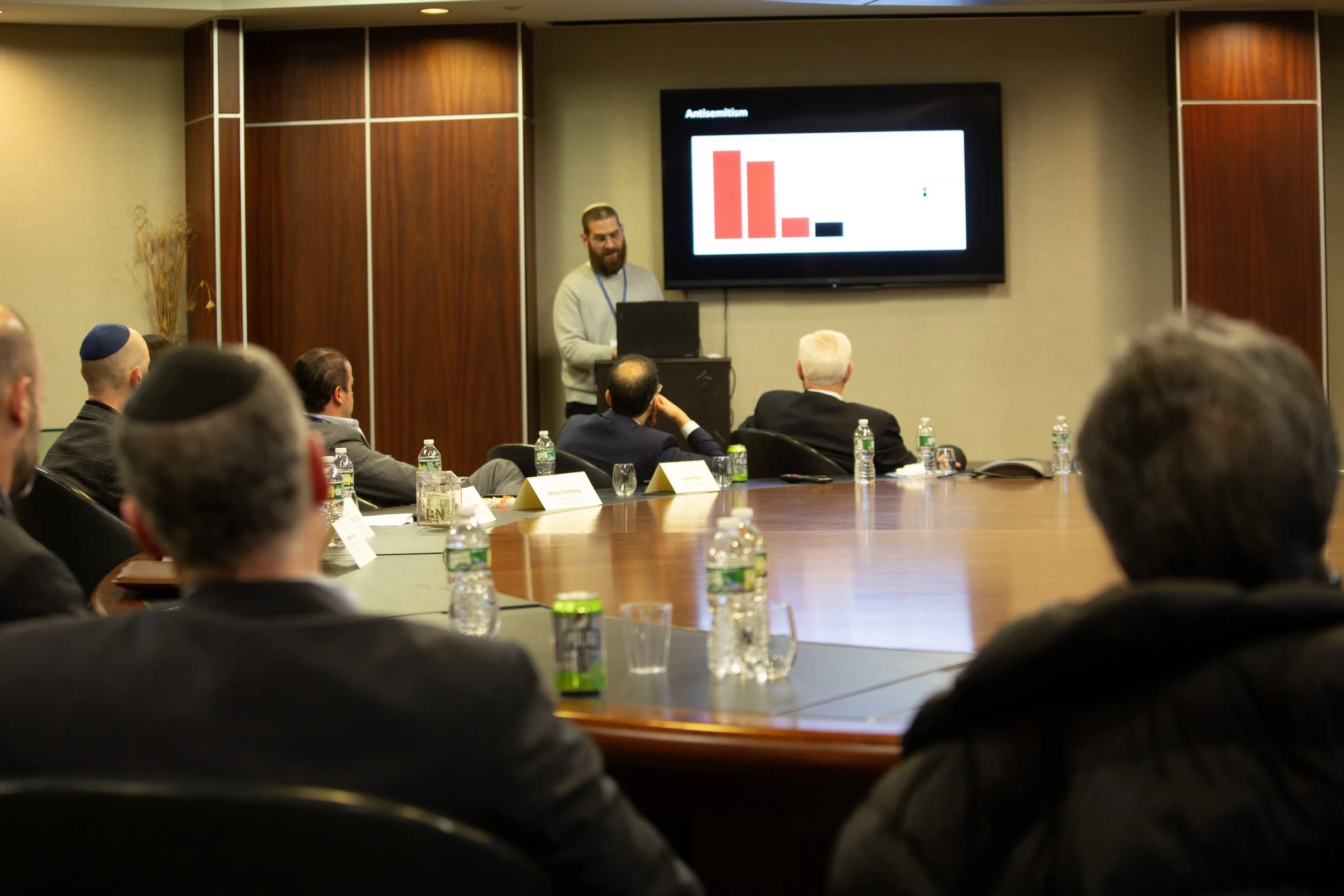
Dr. Joel Finkelstein presenting his research during a recent JBN Executive Roundtable
At a recent JBN Executive Roundtable, we had the privilege of hosting Dr. Joel Finkelstein, Ph.D., Chief Science Officer and co-founder of the Network Contagion Research Institute (NCRI). Dr. Finkelstein’s work pioneers new methods in the cyber social sciences to confront some of the most serious threats of the information age. His research offers a clarifying lens on how antisemitism, hate, and extremism spread; why many well-intended efforts to combat them are failing; and what actually works instead.
This work has drawn the attention of leaders in the United States and abroad. Dr. Finkelstein has briefed members of Congress, congressional staff, law enforcement agencies, and national security officials on online radicalization and antisemitic disinformation. His TikTok research contributed to Congress passing the Protecting Americans from Foreign Adversary Controlled Applications Act. He has also presented its findings in international forums, including the Israeli Knesset, helping decision-makers understand how global antisemitism circulates digitally and manifests offline.
One of the most sobering conclusions to emerge from NCRI’s research is that many dominant approaches to combating antisemitism and racism are not merely ineffective—they may be counterproductive.
For more than a decade, schools, universities, corporations, and nonprofits have widely adopted what is commonly known as the anti-oppressive framework: the belief that morality resides primarily in the struggle between oppressors and the oppressed. While the stated goal of this framework is to eliminate bias and protect vulnerable groups, NCRI’s research suggests that its psychological effects are far more troubling than intended.
When NCRI applied its methodology to antisemitism education materials rooted in this framework, the results were alarming. Participants exposed to these texts reported significantly higher levels of irritation and feelings of being attacked. Their written responses contained dramatically higher levels of antisemitic language than those of participants who read neutral or values-based materials. In other words, attempts to fight antisemitism by centering antisemitism itself sometimes intensified hostility toward Jews.
Why would frameworks designed to reduce bias produce such damaging effects, especially when Jews are involved? When moral life is reduced to identity-based hierarchies and power struggles, suspicion and resentment flourish—particularly toward groups that do not fit neatly into the prescribed categories.
Yet the same science that reveals what does not work also points clearly toward what does.
In a follow-up experiment, participants were exposed not to anti-oppressive texts, but to a short essay titled Universal Human Values, rooted in the Seven Noahide Laws. The essay emphasized justice, honesty, purpose, conscience, and shared moral responsibility. It argued that human dignity does not stem from identity or power, but from the intrinsic worth of the Divine human soul.
The results were unmistakable. Participants exposed to this values-based message showed no increase in defensiveness, antisemitism, or toxicity. They rated the essay as more meaningful, less exaggerated, and less biased than the alternative materials. Many participants reported feeling hopeful, inspired, and reminded of their own moral agency.
The conclusion is difficult to escape: moral education works best when it returns to universal values.
This insight is hardly new. It is embedded in the founding moral vision of the United States, whose architects declared that human beings are endowed by their Creator with inalienable rights. That declaration represented a moral revolution, dismantling hierarchies of power by grounding dignity not in ancestry or status, but in the soul itself. From that dignity flows responsibility—the obligation to recognize the same Divine image in every other human being.
In this week’s Torah portion, Beshalach, the Jewish people find themselves trapped between the sea and the Egyptian army. The Midrash describes four proposed responses: to surrender by casting themselves into the sea, to return to Egypt, to wage war, or to cry out to G-d. G-d rejects them all. “Why do you cry out to Me?” He tells Moses. “Speak to the children of Israel and let them move forward.”
The sea does not split until Nachshon ben Aminadav steps into the water. He understands that the mission is to continue to Mount Sinai to receive the Torah. The obstacle does not define the purpose.
That moment offers a profound lesson for our time. As Israel and the Jewish people face unprecedented challenges in the wake of October 7, we see familiar patterns of response. Some despair and disengage. Others retreat into fear, choosing to keep a low profile. Some turn toward confrontation—through protests, social media activism, or constant argument. Others rely exclusively on prayer, waiting passively for Divine intervention.
These reactions are not unique to antisemitism. They are the same responses people often adopt when facing obstacles in careers, relationships, or communal life. But Torah offers a different path.
We cannot abandon our mission through assimilation or despair. We cannot practice Judaism primarily out of fear. We cannot exhaust ourselves in endless arguments with those who hate us. And we cannot outsource responsibility to G-d alone.
Our mission is proactive: to transform the world by illuminating it with Torah, mitzvot, and moral clarity.
In recent years, many Jewish institutions and philanthropists have begun to realign their energies and resources toward this vision. Funds once devoted almost exclusively to fighting antisemitism have increasingly been redirected toward Jewish education. The UJA Day School Tuition Fund, for example, has committed $15 million over three years to broaden access to Jewish day schools by providing tuition assistance to families seeking to enroll their children in Jewish day school education. The Marcus Foundation has invested millions in adult Jewish education through Chabad’s Rohr Jewish Learning Institute, which now reaches nearly 2,000 communities in 11 languages. JLI has also launched new initiatives aimed at teaching universal moral values to the wider world.
As David Heller, national campaign chair at Jewish Federations of North America, recently observed: “Antisemitism should be fought through education rather than through antisemitism funding. If we don’t have an educated Jewish community, what are we fighting for?”
Antisemitism is not defeated by obsessing over antisemitism. It is defeated by strengthening Jewish identity and spreading the Seven Noahide Universal Moral Values that make hatred untenable.
Let us learn from Nachshon not to be daunted by obstacles and lead by example, bringing ultimate redemption to the world. As Maimonides taught: “A person should always see himself as evenly balanced between merit and sin, and the world as evenly balanced between merit and sin. If he performs one mitzvah, he tips the balance for himself and the entire world to the side of merit, bringing deliverance and salvation.”