The Future is Bright
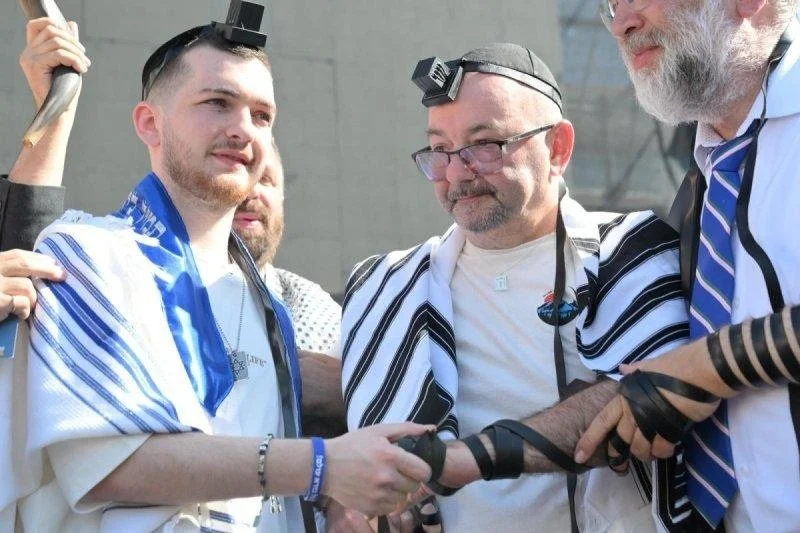
Released hostage Bar Kuperstein and his father wear tefillin at a mass prayer event at Hostages Square in Tel Aviv on October 31, 2025
Bar Kuperstein was a medic who was kidnapped by Hamas after staying behind at the Nova Festival to care for the wounded.
Years earlier, Bar had already assumed enormous responsibility. After his father, Tal—a fellow paramedic—was paralyzed in a car accident, Bar became the primary breadwinner for his family.
In the aftermath of Bar’s abduction, his mother, Julie Kuperstein, launched an extraordinary and deeply personal initiative. Rather than turning to politics or media campaigns, she asked Jewish men around the world to don Bar’s tefillin—and the tefillin of other captive men—in their merit.
The response was overwhelming. Tens of thousands answered her call. Many who had not worn tefillin regularly committed to putting them on every day until the hostages were returned, and some resolved to continue even afterward.
Julie never sought the spotlight. A naturally private person, she chose a different path—one of prayer, faith, and acts of goodness in the merit of her son and all those held captive.
That decision led to an astonishing moment.
One day, Julie received a phone call. Speaking in heavily accented Hebrew, the caller identified himself as a Hamas terrorist holding her son.
“You families of hostages have a lot of power,” he said, “but you are not doing anything.”
Julie replied calmly, “You don’t know what I do or don’t do. I pray, and I create merits for Bar and for the other hostages.”
The terrorist then threatened that if she ever wanted to see her son again, she must protest publicly, criticize Israel internationally, and work to topple the Israeli government.
Julie answered without hesitation:
“I am not afraid of you. My Bar is not in your hands. He is in the hands of the Creator of the world. And you, too, are in the hands of the Creator of the world.”
There was a brief silence.
Then the terrorist said simply, “Well done, madam.”
Julie often speaks about a song that gives her strength: “ואפילו בהסתרה שבתוך ההסתרה”—
“Even in the most concealed of concealed places,
certainly He of the blessed Name is found there.
I stand with you, even through the hardest moments.”
Based on the teachings of Rabbi Nachman of Breslov, the song conveys a profound truth: even when goodness feels entirely hidden, even in the deepest darkness, G-d is still present with us.
Bar later shared that this song sustained him during the two years he was held in Hamas’ underground tunnels.
After his release, Bar spoke publicly for the first time at Hostages Square in Tel Aviv. Standing before the crowd, he extended a moving invitation:
“This Friday at ten in the morning, I want us to lay tefillin together.
Fulfill my dream with me. My dream was to lay tefillin while in captivity.
Let’s do it for the freedom of our brothers who are still being held.”
With these words, Bar expanded the tefillin initiative his mother had begun—transforming private faith into a collective act of hope.
In this week’s Torah portion, Bo, we encounter the first mitzvah given to the Jewish people before their Exodus from Egypt: Kiddush HaChodesh, the sanctification of the new moon. This commandment establishes the Jewish calendar and sets the rhythm of Jewish life—holidays, life-cycle moments, and sacred time itself.
Unlike the solar calendar, the Jewish calendar follows the moon. While the sun’s light remains steady and unchanging, the moon waxes and wanes. The Talmud teaches that the Jewish people resemble the moon and count by the moon.
Just as the moon’s light diminishes and becomes concealed, the Jewish people endure periods of darkness. Yet the moon’s renewal each month reminds us that concealment is never permanent. Decline is followed by rebirth. Darkness gives way to redemption.
After generations of brutal slavery, G-d taught this lesson to the Jewish people while they were still in Egypt: never give up in the face of adversity. Throughout our history, we have experienced extraordinary highs and devastating lows—and yet, miraculously, we endure.
The moon’s cycle teaches us to remain hopeful during hardship and humble, grateful, and generous in times of blessing. In fact, when the moon is hidden, it is actually closest to the sun, its source of light. In the same way, in moments that feel dark and concealed, we are often closest to G‑d.
This coming week, on the tenth of Shevat, we commemorate the anniversary of when the Rebbe, Rabbi Menachem Mendel Schneerson, assumed Chabad leadership in January 1951.
Guiding a generation emerging from the ashes of the Holocaust, the Rebbe empowered individuals never to surrender to despair. He taught that every person carries a divine spark waiting to be revealed, and that each of us has a role in illuminating the world.
Despite enduring Nazi and Soviet persecution and facing apathy and opposition even in America, the Rebbe launched a historic revitalization of Jewish life—establishing schools, youth movements, publishing houses, adult education programs, professional networks, and humanitarian initiatives across the globe.
In his inaugural address, the Rebbe declared that our generation was entrusted with completing the mission begun by our forefather Abraham: to reveal the Divine within creation and transform this world into a home for G-d, ushering in the final redemption.
Interpreting King Solomon’s words in the Song of Songs, “I have come to My garden, My sister, My bride,” the Rebbe taught that the world was always meant to be a beautiful garden. The darkness and concealment we encounter are merely external. Our task is to uncover and reveal the inherent goodness embedded within the world around us.
He emphasized that love for G-d, love for Torah, and love for the Jewish people are inseparable. Loving others unconditionally creates a dwelling place for the Divine.
As Rabbi Jonathan Sacks so poignantly observed:
“If the Nazis hunted down every Jew in hate, the Rebbe would search out and reconnect every Jew in love.”
In the face of the darkness confronting the Jewish people today, we must remain focused on our mission. We have faith that we are entering the dawn of a new era. Let us perform one more mitzvah, bring one more act of light into the world, and hasten the final redemption—when peace and harmony will prevail for all humanity!