The Power of Transformation: From Gaza to Times Square
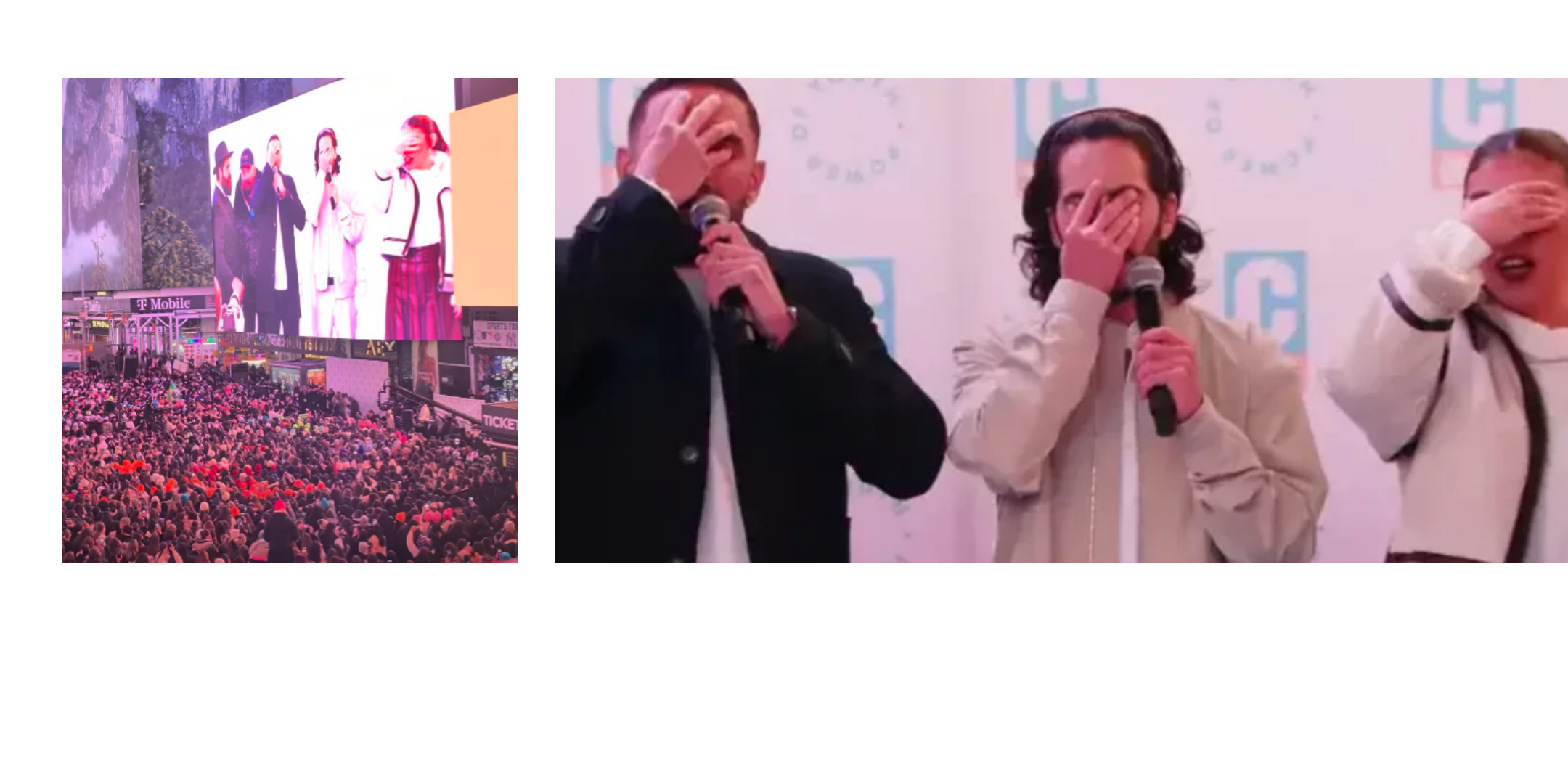
Freed Israeli hostages Matan Zangauker, Ilana Gritzewsky, and Segev Kalfon, recite the Shema prayer on stage in Times Square on February 21, 2026, in front of 5000 Jewish teens.
When Segev Kalfon was held hostage in Gaza, he witnessed fellow captives paraded on stages before evil crowds in cruel propaganda spectacles. In the suffocating darkness of the tunnels, he made a quiet vow: if he were ever put up on that stage, he would use it not for humiliation — but for faith. He dreamed of declaring Shema Yisrael, Judaism’s timeless proclamation of unity, before the very savagery that sought to break him.
By the time he was released, the staged ceremonies had stopped. The captors had removed the platform.
So he found another one.
This past Saturday night, at a Havdalah ceremony and concert marking the conclusion of Shabbat in Times Square — surrounded by more than 5,000 Jewish teens from over 60 countries gathered for Chabad’s CTeen international Shabbaton — he fulfilled his vow. As towering billboards flashed Jewish messages and mitzvot across the New York skyline, Segev stood in the heart of Times Square and declared, “I dreamed of saying Shema on the stage of Hamas, but that show was canceled. So today, I say it for the whole world to hear.” With deep emotion, he then sang the Shema Yisrael prayer— and thousands responded in unison.
Consider the contrast: Times Square — not known as a sanctuary of spirituality. Thousands of teens who might ordinarily hesitate to display their Judaism publicly. And a former hostage who could have emerged broken and crushed — instead choosing to proclaim Jewish faith openly and proudly.
That is transformation.
Crushed for Light
In this week’s Torah portion, Tetzaveh, we are commanded to bring “pure olive oil, crushed for lighting,” to kindle the Menorah. The olive yields its finest oil only when pressed. Without pressure, there is no illumination.
Our sages explain that this is not incidental symbolism. The Jewish soul, like the olive, often reveals its purest essence when squeezed. Hardship can extract what comfort conceals — faith, resilience, moral clarity. What appears to be crushing can become the very mechanism that generates light.
Throughout history, the Jewish people have faced external pressures that forced us to define who we are. Yet in more comfortable times, a subtler challenge emerges: How do we reveal our inner light without being compelled by crisis? How do we choose identity and mission not because we must — but because we will?
Being chosen was never about privilege. It is about purpose. To be “a light unto the nations” means transforming adversity into illumination rather than allowing it to produce despair.
Oil itself carries a profound metaphor. It does not mix with other liquids — symbolizing identity and resilience. Yet it permeates and illuminates — symbolizing influence and purpose. The Jewish people have embodied both traits: distinct, yet impactful; separate, yet radiant.
The deeper message of Tetzaveh is not that we require suffering to access faith. It is that when pressure comes, it can release something luminous rather than destructive.
Transformation is not accidental. It is rooted in connection. The word Tetzaveh shares its root with tzavta — connection. A mitzvah is not merely a command; it is a bond between the human and the Divine, between the physical and the spiritual.
Purim: The Holiday of Reversal
No holiday embodies transformation more vividly than Purim. Its theme is v’nahafoch hu — complete reversal. A decree of annihilation becomes a celebration. Fear becomes festivity. Vulnerability becomes unity.
Unlike Chanukah, which celebrates spiritual resistance, Purim celebrates physical survival. The threat was annihilation, and so the response embodied joy — feasting, gifts, generosity, and unity. The physical itself becomes holy.
Haman described the Jewish people as “scattered and dispersed,” implying weakness and fragmentation. Similarly, after October 7, the IDF reported discovering Hamas planning documents outlining a detailed blueprint for a large-scale assault on Israeli border communities and military bases. According to reports, additional internal assessments from Hamas indicated that it viewed Israel as internally weakened amid deep societal divisions, believing this fragmentation created a strategic opportunity.
But they were profoundly mistaken. Just as in the days of Purim, when Mordechai’s response was clear and powerful — “Go gather all the Jews” — so too in our time, the Jewish people demonstrated that our divisions were only external. Beneath the surface, we are deeply united. Unity became the antidote. Connection became the catalyst for redemption.
Purim teaches that redemption is not merely escape from danger. It is the transformation of the narrative itself.
The very day Haman chose to annihilate the Jews became the day of our victory and his downfall. In fact, the very name Purim — derived from the Persian word pur, meaning “lot,” referring to the lottery Haman cast to select an auspicious date for destroying the Jewish people — became the name and reason for our celebration.
The Midrash teaches that in the future era of redemption, all holidays will blend into the rhythm of daily joy — except Purim. Why? Because Purim represents the highest spiritual achievement: discovering holiness within the ordinary, finding purpose within chaos, revealing hidden light within concealed circumstances. That is the very essence of Moshiach and redemption — a world transformed, where we connect with the ultimate purpose of creation and uncover meaning even within the mundane.
May we merit to witness the complete eradication and transformation of evil, and may Israel and the Jewish people live in lasting peace with all our neighbors, with the coming of Moshiach speedily in our days. May we celebrate Purim together this year in Jerusalem. L’chaim!