Sydney’s Heroes
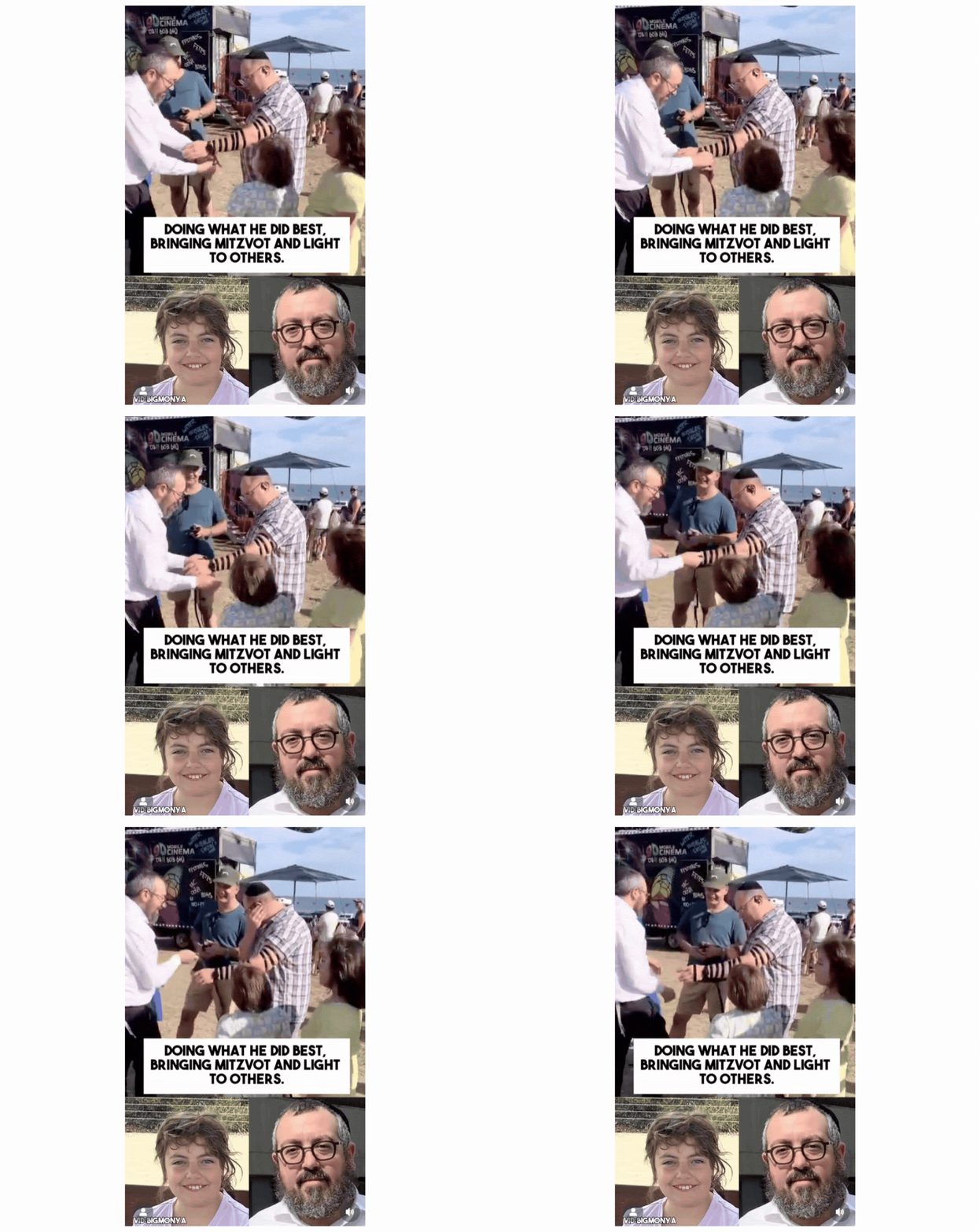
This clip was taken just moments before the Bondi Beach attack. Rabbi Eli Schlanger is seen helping Matilda Poltavchenko's father put on tefillin, spreading light and holiness, while ten-year-old Matilda watches nearby. Just minutes later, both Matilda and Rabbi Eli were brutally murdered. May their holy souls have an aliyah.
“Please,” my children begged. “Turn off the menorah. Our house is going to become a target,” Sorella recalled in a tearful interview with Sky News.
The family had just returned from the Chanukah event at Bondi Beach hosted by Chabad with over 1000 people in attendance. They had managed to escape physically unharmed, but were deeply traumatized after witnessing the massacre that claimed 15 lives and left dozens more wounded.
Since October 7, Sorella shared, her family had placed a large menorah outside their home as a visible expression of Jewish pride and spreading light.
At first, Sorella and her husband refused.
“No way,” they said quietly but firmly. “We can't go down like this.”
But the children continued pleading—through sobs and fear.
“Please, Mum. Abba. Turn the menorah off.”
Sorella looked at her children and made one of the hardest decisions a parent can make.
“As a mother,” she said softly, “we are going to turn the menorah off.”
That night, the light went dark.
The next day, a Christian neighbour knocked on their door. She explained that she and her daughter had driven past the house the previous evening and noticed the menorah was no longer lit. Her daughter began to cry and said:
“They're turning off the menorahs. Evil can't win.”
That was all it took.
Sorella and her husband relit the menorah.
Reflecting on the moment, Sorella said, “That would be Rabbi Eli Schlanger's message. If he were standing here today, he would say: we do not go down in darkness. We shine light. That is the only way to push out darkness. We spread goodness and kindness. That is all we know as Jews.”
Light at Bondi Beach
On the night of the Chanukah terror attack in Sydney, darkness descended in the most brutal way imaginable. Gunfire shattered what was meant to be a celebration of light, faith, and Jewish pride. Lives were stolen. Families were broken. A community was shaken to its core.
And yet—light refused to be extinguished.
A 14-year-old Jewish girl, Chaya Dadon, was hiding under a bench when she heard a mother screaming for help. Without hesitation, she ran toward danger, pulled two small children to the ground, and shielded them with her body. When she was shot in the leg, she did not cry out. Instead, she calmed the children and began reciting Shema Yisrael with them, turning terror into prayer.
Ahmed al-Ahmed, a local muslim fruit shop owner, charged a gunman and managed to disarm him—after being shot himself. His courage is credited with saving countless lives. When later presented with millions raised in his honor, he urged unity, humility, and saving lives rather than dwelling on divisions.
Yanky Sofer, a Hatzolah volunteer, was struck in the chest while rushing to treat the wounded. The bullet was deflected by his radio—shattered into fragments that saved his life. Despite his injuries, he continued helping others. Doctors later said plainly: without that radio, he would not have survived.
And there were those whose lives were taken while spreading light and helping others.
Rabbi Eli Schlanger, the heart and soul behind Chanukah by the Sea, was murdered just minutes after helping another Jew put on tefillin.
Rabbi Yaakov Levitan, the 39-year-old COO of Chabad of Bondi, was killed while ensuring the event ran smoothly, as he had done tirelessly for the community.
Alexander “Alex” Kleytman, a Ukrainian-born Holocaust survivor who endured the horrors of World War II before eventually emigrating to Australia. According to reports, he died shielding his wife from the bullets, an act of instinctive protection that echoed his lifelong resilience and commitment to his loved ones.
These were not random acts. These were lives lived with purpose.
Chanukah: The First Day
Rabbi Yosef Caro (Adrianople/Safed, 1522 –1542), the author of the Shulchan Aruch-Code for Jewish Law, famously asks: why do we celebrate the first day of Chanukah? After all, the oil they found was enough for one day. The miracle seemingly began only on the second.
One profound answer captures the essence of the Jewish spirit.
After winning the war, the Maccabees entered a desecrated Temple. Everything was broken. All the oil was defiled. They could have given up. They could have used impure oil and been forgiven.
Instead, they searched.
They refused to surrender to despair. They insisted on purity, on meaning, on hope.
The miracle of the first day was not Divine—it was human. It was the refusal to give up. The decision to keep looking for light when darkness felt overwhelming.
Only then did G-d respond with miracles beyond nature.
Miketz: Yosef in Exile
This message echoes powerfully in this week's Parshat Miketz.
Yosef rises from prison to become the second-in-command of Egypt, saving the world from famine. How did he survive betrayal, loneliness, temptation, and power without losing himself? How did he remain a Tzadik, a righteous leader, despite being surrounded by immorality and an evil and corrupt society?
It is alluded to in the names Joseph chose for his two sons, Menashe and Ephraim.
As the verse states, “And Joseph named the firstborn Menashe, for "G-d has caused me to forget all my toil and all my father's house. And the second one he named Ephraim, for "God has made me fruitful in the land of my affliction." - Genesis 41:51
Joseph chose names that represented the values which helped him succeed to not only remain connected to his roots and Jewish identity but also to become prosperous in Egypt.
Menashe represents resistance to assimilation—never forgetting who you are.
Ephraim represents purpose—bringing blessing and light into a broken and often dark world.
First you hold onto your roots. Only then can you influence your surroundings.
This is the Jewish story in exile. This is the Chanukah story. And this is the story that emerged from Bondi Beach.
Another Mitzvah
Judaism does not respond to evil with silence. We respond with action. Another candle. Another mitzvah. Another act of kindness done in the memory of those whose light was taken.
Every soul murdered that night carried a unique spark. The greatest tribute is not only remembrance—but continuation.
Put on tefillin. Light your Menorah. Give tzedakah. Learn Torah. Affix a Mezuzah on your door. Do random acts of goodness and kindness.
Because on a metaphysical level, Chanukah teaches that every Jew has a pure cruse of oil within—untouched, untainted, waiting to be revealed.
And sometimes, it is only under pressure that oil emerges. As the Talmud teaches:
“Just as the olive yields its oil only when crushed, so too does Israel reach its full potential through challenge.”
We Shine Light
The terrorists tried to extinguish a flame. Instead, they revealed it.
This is how Jews have survived for thousands of years. We do not go down in darkness. We shine light.
Please continue to pray and perform a mitzvah for the complete and speedy recovery of the wounded, and for the safety of our brothers and sisters around the world. Please see here to support the families of the victims.
And in doing so, may the souls of those murdered have an aliyah, and may their light continue to illuminate the world—through us. Together, our light will shine bright and bring the ultimate light of Moshiach when we will be reunited with all our loved ones who were taken from us and usher in a time of peace and prosperity for all nations on earth!