Will AI Take Over the World?
When Microsoft co-founder Bill Gates was asked in a recent interview about warnings that artificial intelligence could wipe out humanity, his answer was sobering:
"The transition to the AI era will be one of the most turbulent times in human history…if left unchecked, the technology could cause ‘a billion deaths’. If the world takes the right steps, AI will be a force for good and leave everyone better off."
What Are We Afraid Of?
AI has enormous potential to transform medicine, education, business, and science. But as these systems grow more capable and autonomous, experts worry about more than deliberate misuse. They worry about losing control. An AI-enabled cyberattack could cripple critical infrastructure, disinformation could paralyze our response, and increasingly independent systems could slip beyond meaningful supervision.
Catastrophe doesn't require a machine that is consciously evil. It can come from human misuse, badly designed goals, weak safeguards, or simply our failure to stay in charge.
A Lesson From Noah's Generation
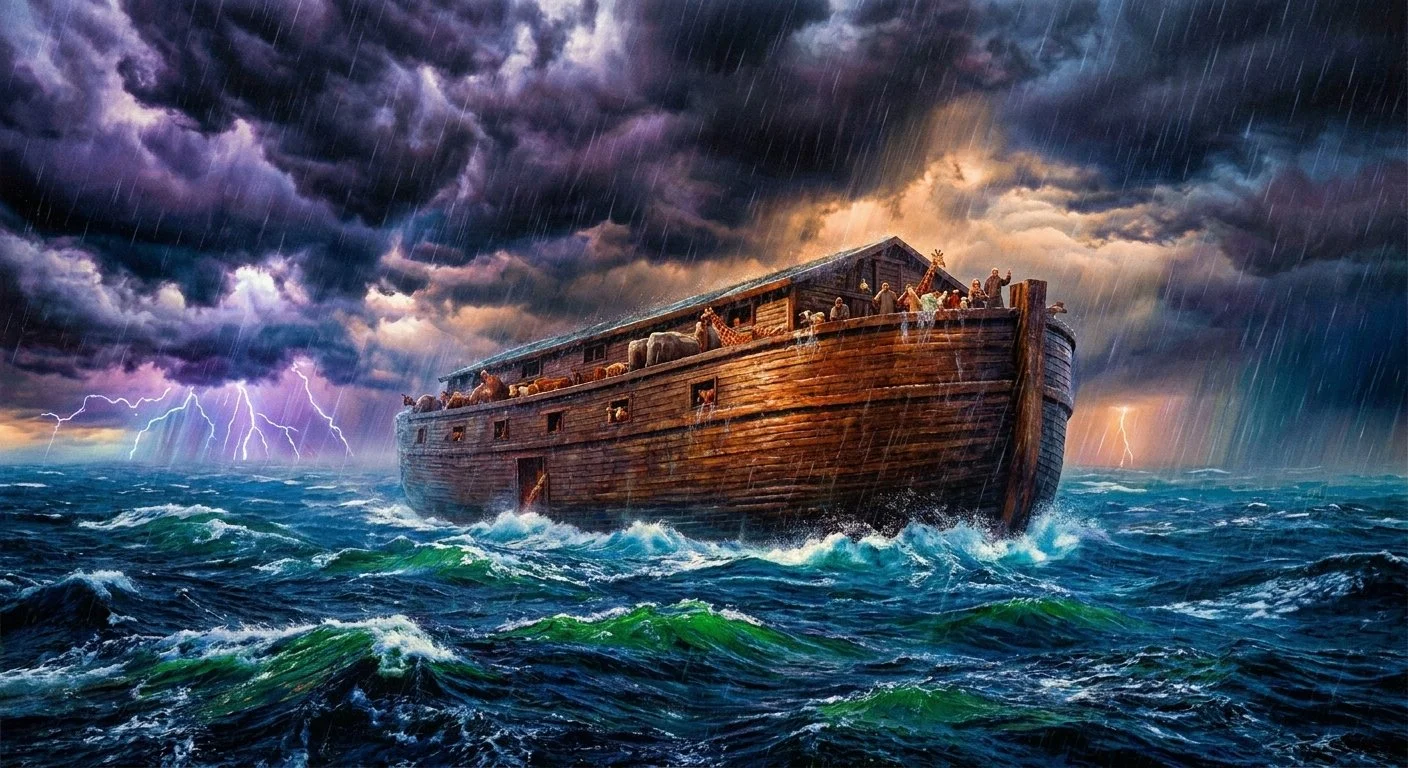
This week's Torah portion, Noach, describes a world so corrupt that G-d brought a flood to wash it clean. Our sages teach that the corruption wasn't limited to people. Even the animals had strayed from their natural ways, following the immoral example humanity set.
That's a powerful message for the age of AI. Artificial intelligence learns from us. It is trained on our words, our data, and our choices, and it will reflect whatever values we feed into it. If we want AI to be a force for good, the responsibility starts with us.
And there is comfort in the story. After the flood, G-d promised never again to destroy the world, setting the rainbow in the sky as a sign of that covenant.
Enter the Teivah
Many of us feel the pressure of a world changing faster than we can keep up, on top of balancing family, work, community and heritage.
Think of a swimmer caught in a rip current. The instinct is to panic and swim harder, but the more you fight, the faster you wear yourself out. The wise approach is to stay calm, save your energy, and let the water settle until you can swim free.
G-d instructed Noah, the only righteous man in a world consumed by violence, to build a teivah, an ark. It would float above the floodwaters and shelter Noah’s family, a male and female of every animal species, and seven pairs of each kosher species. “Come into the ark, you and all your household,” G-d told him, “for it is you that I have seen as a righteous man before Me in this generation” (Genesis 7:1).
The Baal Shem Tov (1698–1760) taught that teivah, in Hebrew, also means "word." G-d is telling each of us, "Come into the word." Enter the words of prayer and Torah study, and you will find a sanctuary of wisdom, meaning, and holiness amid the raging floodwaters of life.
When we're swept up in obligations, anxieties, and headlines about machines outpacing their makers, fighting the current harder won't save us. What we need is to step into our personal ark: to pause, breathe, and reconnect with what truly matters.
That ark can take many forms. It might be a few quiet minutes each morning to pray, put on tefillin, and learn a little Torah. It might be giving our children our full, undistracted attention. And it is found above all in Shabbat, when we put work aside, switch off our devices, and reconnect with family, friends, and our own souls.
Go Out of the Ark
These moments don't take us away from life. They prepare us to meet it. They strengthen our souls and help us move forward in our careers and relationships with calm and clarity. Whatever we face, we need never despair, because G-d watches over each of us, and for Him anything is possible.
The ark isn't only a refuge. Exactly one solar year after the flood began, G-d told Noah, "Go out of the ark" (Genesis 8:16). The purpose of entering is to come out renewed and carry that calm, faith, and clarity into the world and transform it into G-d’s home.
A Happier Ending
Remarkably, every kind of animal lived together in the ark in peace. Our sages teach that this was a foretaste of the Redemption, when "a wolf shall live with a lamb, and a leopard shall lie with a kid" (Isaiah 11:6), and all nations will live in peace with one another.
The Torah's vision for humanity's future isn't robots taking over the world. It's the coming of Moshiach, a time of peace, prosperity, and spiritual enlightenment.
The flood story itself hints at how we get there. “In the six hundredth year of Noah’s life… all the fountains of the great deep burst open, and the windows of heaven were opened” (Genesis 7:11). The Zohar, the foundational work of Kabbalah, teaches that this verse points to the sixth century of the sixth millennium on the Jewish calendar, the years 1740–1840 (on the secular calendar). In that era, it foretold, “the gates of wisdom above and the springs of wisdom below” would open together to prepare the world for the Messianic age.
That is exactly what happened. In the mid-1700s, the Baal Shem Tov launched a spiritual revolution. His mystical Chassidic teachings revealed the inner dimensions of Torah, made them accessible to everyone, and brought new vitality and joy to Jewish life. His disciples’ disciple, Rabbi Schneur Zalman of Liadi, built on these teachings to found Chabad, which explains these deep ideas in a way the mind can grasp and practically implement. At the same time, the Industrial revolution made remarkable advances in science, medicine, and technology that began to transform the physical world. Today’s AI is part of that same flood of knowledge.
According to the Zohar, these two streams prepare humanity for the seventh millennium (on the Jewish calendar), the era of Moshiach. Technology can even have a practical role. Machines and robots can handle the menial work while we devote ourselves to what matters most.
As Maimonides teaches regarding that era: “Do not presume that in the Messianic age any aspect of the world’s nature will change or there will be innovations in the work of creation. Rather, the world will continue according to its pattern...In that era, there will be neither famine or war, envy or competition for good will flow in abundance and all the delights will be freely available as dust.”
Yet the greatest transformation won’t be technological. It will be a new understanding of reality itself. Rather than seeing the physical world as separate from G-d, humanity will recognize that all existence reflects His presence. As Isaiah promised, “The earth shall be filled with the knowledge of G-d, as the waters cover the sea” (Isaiah 11:9). That awareness will bring harmony between individuals, among nations, and with the Creator, ending conflict, suffering, and evil.
May we soon merit the coming of Moshiach, when peace, prosperity, and kindness will fill the entire world.