The Sukkah on the USS Abraham Lincoln
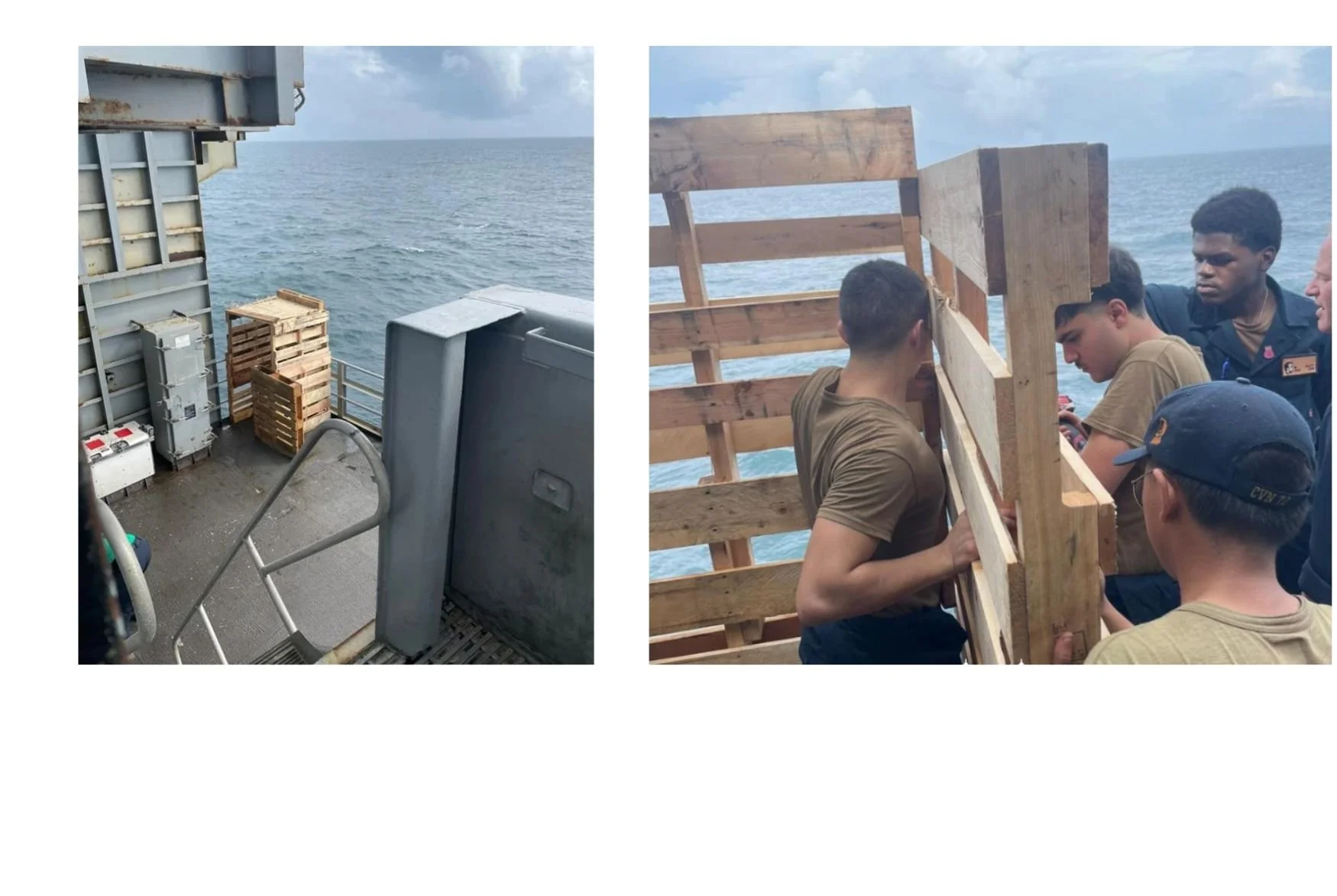
The Sukkah built on the USS Abraham Lincoln in 2024
In 2024, in the middle of its deployment across the Pacific and into the Arabian Sea, on a mission defending Israel and deterring Iranian aggression, amid the roar of jet engines and the constant motion of a carrier at sea, something unexpected was built on the deck of the USS Abraham Lincoln.
A kosher sukkah.
The first known to be constructed on a U.S. Navy warship underway.
The idea came from a simple question: How could the Jewish sailors aboard observe Sukkot — a holiday whose central mitzvah requires dwelling in a temporary structure — while deployed at sea? Lieutenant Yehoshua Rubin, a Chabad-Lubavitch chaplain serving with Carrier Air Wing Nine, brought the question to the ship's Command Religious Ministries Department.
The response could have been: "That's impossible." Instead, Chaplain Brian Davenport saw an opportunity.
What followed was a ship-wide effort. The Air Department reviewed the plans to ensure the structure wouldn't interfere with flight operations. Handlers made certain no aircraft wing would extend over the sukkah while it was in use — preserving its halachic (Jewish legal) requirements. The Supply Department located clean shipping pallets to serve as walls. The Deck Department contributed its expertise to construct a sturdy sukkah, secured beneath the open sky of the weather deck. A lulav and esrog were flown in from Bahrain on a carrier onboard delivery aircraft, arriving just in time.
What started as a request from a handful of Jewish sailors became something larger. Sailors from different backgrounds joined in — asking questions, helping with construction, learning about the holiday and its meaning. The Abraham Lincoln was later honored with the inaugural CPL Tibor Rubin Unit of the Year Award for its commitment to accommodating the religious needs of its crew.
But the deeper story is connected to the meaning of the holiday of Sukkot.
A Divine Embrace
The biblical mitzvah of sitting in a sukkah commemorates the "clouds of glory" G‑d provided for the Jewish people during their forty years in the desert — a visible, encompassing divine protection that accompanied them every step of the way.
Throughout the year, our lives carry a sense of permanence: our homes, our careers, our routines, our plans. Once a year, Sukkot invites us to step outside all of that and dwell in a temporary booth — to recognize that ultimately we are in G‑d's hands, and that He has been taking care of us throughout our long history, just as He did for our ancestors in the wilderness.
There is something profound about the structure of the mitzvah itself. Unlike most commandments, which are performed with one part of ourselves — our hands, our voice, our resources — stepping inside a sukkah envelops the entire body. It is less like performing an act and more like receiving an embrace. Like a child held in their parent's arms, aware that all their needs are met simply by being there.
The Talmud captures the breadth of this embrace in a striking statement: "All of Israel is fit to sit in one sukkah" (Sukkah 27b).
This is not as obvious as it sounds. The Jewish people are not uniform. We have different personalities, backgrounds, professions, levels of observance, and perspectives. We don't always agree. We don't always understand one another.
Sukkot doesn't ask us to erase those differences. It asks us to bring them together.
The Four Species
The mitzvah of the Four Species makes this point with striking clarity.
The Midrash compares the etrog (citron), lulav (palm fronds), myrtle, and willow to four types of Jews: the etrog, with both taste and fragrance, represents one rich in Torah knowledge and good deeds; the lulav, with taste but no fragrance, represents one with learning but fewer deeds; the myrtle, with fragrance but no taste, represents one whose good deeds exceed their scholarship; and the willow, with neither, represents one who seems to lack both.
What do we do with them? We bind all four together, recite a blessing, and wave them in every direction.
Even the etrog — representing the highest combination of Torah and good deeds — cannot fulfill the mitzvah alone. It must be held alongside the humble willow. The lesson is unambiguous: no individual is complete in isolation. Every person has something unique to contribute, and every person has something to receive from someone else. Unity doesn't come from eliminating our differences. It comes from recognizing that our differences can complete one another.
From the High Holidays to Sukkot
There's a progression here worth pausing on.
During Rosh Hashanah and Yom Kippur, we strip away our external identities and reconnect with our deepest selves. At the level of the soul, every Jew shares a fundamental bond — a connection to G‑d that transcends background and personality. The High Holidays reveal a unity that was always there.
But spiritual unity experienced only in the synagogue can remain abstract. We leave Yom Kippur feeling close to something essential — and then return to daily life, where it becomes easy to once again see ourselves as separate individuals.
Sukkot makes a harder and ultimately more powerful demand: remain united, even while being different.
We eat together in the sukkah. We drink together. We invite guests — ushpizin — into our temporary home. The holiday doesn't merely teach unity as a concept. It enacts it, physically, in a structure open to the sky and to whoever walks through the door.
This is why Sukkot is called Zman Simchateinu — the Time of Our Rejoicing. The joy of Sukkot isn't a passing emotion. It's what arises when people experience genuine connection — when they recognize that they belong to something larger than themselves.
The Aircraft Carrier and the Sukkah
An aircraft carrier is, in many ways, a perfect illustration of this kind of unity. Pilots, engineers, deck crews, chaplains, supply officers, mechanics — each carries a distinct responsibility that no one else aboard can perform. No single person operates the ship. The mission depends entirely on interdependence.
The sukkah on the Abraham Lincoln reflected that same reality. One department reviewed aviation requirements. Another provided materials. Another built the structure. Chaplains and sailors together ensured the halachic requirements were met. Others simply asked questions and learned something new.
Every contribution was different. Together, they made something none of them could have made alone.
That is the Jewish vision of unity: not uniformity, but complementarity. A symphony is meaningless if every musician plays the same note. A team accomplishes little if every player has the same role. A community is diminished when it expects everyone to contribute in exactly the same way.
Each person carries a unique soul, a unique set of gifts, a unique mission. The question Sukkot asks is not why is this person different from me? It is how can our differences help us accomplish something greater together?
The Sukkah We Are Still Building
Every year on Sukkot, we recite a prayer drawn from the prophet Amos: הָרַחֲמָן הוּא יָקִים לָנוּ אֶת סֻכַּת דָּוִד הַנּוֹפֶלֶת — "May the Merciful One raise up for us the fallen sukkah of David."
In the time of Moshiach, all Jews from across the world will return to Israel — reunited not despite their differences, but through them, living in peace and prosperity alongside all nations. That is the ultimate fulfillment of the sukkah's promise: one structure, big enough to hold everyone.