The Multiplier Effect
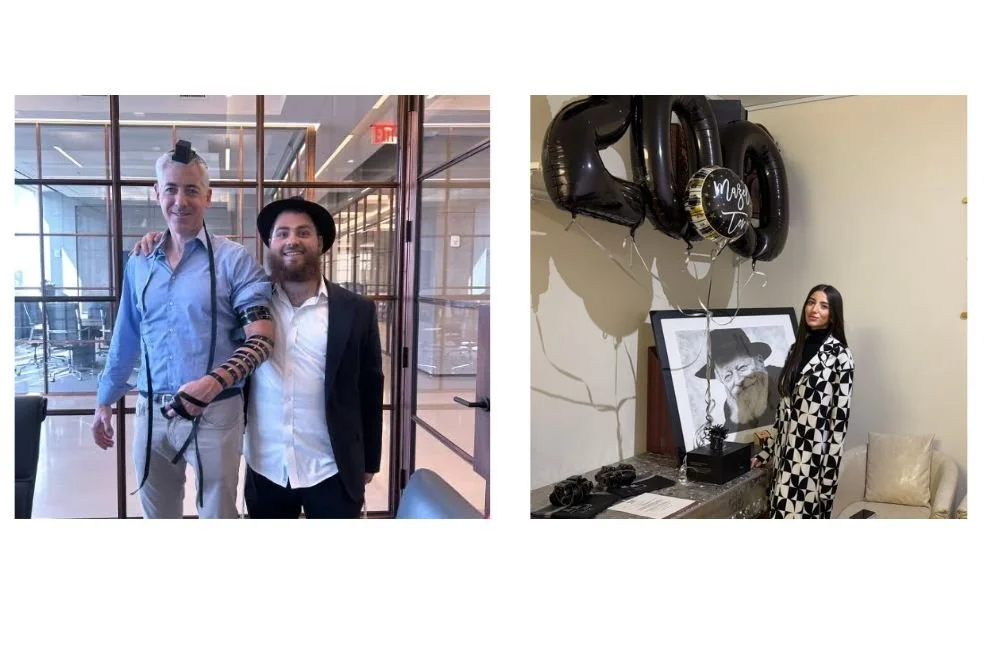
Right: Mary Jarada celebrating the purchase of her 200th Pair of Tefillin | Left: Yossi Farro assisting Bill Ackman with putting on Tefillin for the first time
In the weeks after the Hamas-led terror attacks on October 7, 2023, Mary Jarada sat in her New York office searching for something meaningful she could do for the Jewish people. Leading a financial firm, she landed on an unexpected idea: when calling male clients to close deals, she would ask whether they had remembered to wrap their tefillin that morning.
"A lot of them responded, 'Oh my G-d, I forgot — I'll do it right now,'" she recalled.
She formed a WhatsApp group, made a flier, and began connecting people in need of tefillin with donors willing to help. Five requests became ten, then more. She turned to social media to raise funds, and "Tefillin on Us" was born. The men who reached out spanned a wide spectrum, observant Jews who couldn't afford a new pair, single mothers seeking tefillin for their bar mitzvah-aged sons, and people who had never wrapped tefillin in their lives.
The men whom she provides with tefillin “have the most incredible, heartbreaking and inspiring stories,” she shared. “You never know what this mitzvah can spark in someone’s life.”
In January 2025, Jarada arrived at Machon Stam, a Brooklyn Sofer (Scribal Shop), to pick up her 200th sponsored pair, and was greeted with a surprise party. Her foundation, Ein Od Milvado ("There Is No Other Besides Him"), had raised over $135,000 at the time.
Putting Tefillin on the Famous
Meanwhile, a young yeshiva student in Los Angeles was doing something similar, one encounter at a time. As a typical teenage Chabad yeshiva student, Yossi Farro spent his Friday afternoons visiting local business people or approaching strangers on the street, offering them the opportunity to do a mitzvah, inviting men to put on tefillin and women to light Shabbat candles.
One afternoon, Farro offered to help a passerby wrap tefillin, not knowing the man was rapper Lil Dicky. Not long after, he did the same with actors James Franco and Jeremy Piven. Educated in a protected Jewish enviroment with little exposure to secular culture, these names meant nothing to him. But the response when he posted the photos was overwhelming. He realized that if public figures wrap tefillin openly, it reaches millions of young Jews who might otherwise feel their Jewish identity is something to keep quiet.
Since then, Farro has traveled the world, wrapping tefillin with well-known celebrities and public figures, including investor Bill Ackman, music executive Scooter Braun, Shopify President Harley Finkelstein, and KIND Snacks founder Daniel Lubetzky. By sharing these encounters on social media, he has generated millions of views, sparking interest and inspiring countless other Jews to put on tefillin themselves.
While humility and modesty are typically the ideal, the Rashba (1235-1310 Barcelona, Spain) famously declared that "it is a mitzvah to publicize those who perform mitzvot." In an age of rising antisemitism, openly celebrating Jewish identity is not vanity, it is a necessity.
The Rebbe's Campaign — and the Six-Day War
While Jewish men have been wrapping tefillin since the giving of the Torah over 3,300 years ago, the modern era brought new challenges. As secularism spread and assimilation became increasingly common, many Jews grew disconnected from traditional observance. For some, wearing tefillin came to seem unfamiliar, outdated, or even uncomfortable to practice publicly. Over time, this sacred daily mitzvah was forgotten by many.
The modern mass movement of public tefillin-wrapping and its resurgence in recent years, traces its roots to June 1967. On Saturday, June 3 — two days before Israel's Six-Day War — the Lubavitcher Rebbe launched his iconic Tefillin Campaign, citing the Talmud (Berachot 6a): when Jews wear the head tefillin, "all the nations of the earth will see that the Name of G-d is called upon you, and they will be in awe of you."
His call was urgent. Telegrams went out to Israel that night. By morning, 100,000 leaflets had been printed and distributed to army bases. Chabad activists spread out to military posts and bus stations, offering soldiers the chance to wrap tefillin before battle.
On June 5, Israel launched a preemptive strike and destroyed the Egyptian Air Force within hours. In six days, three Arab armies were routed, Jerusalem was reunified, and Israel tripled its territory. When the Western Wall reopened, Chabad set up a tefillin stand immediately. On the first day alone, 200,000 people visited — including Generals Dayan, Weizman, and Sharon — and within a year, over a million Jews had performed the mitzvah there. A wartime measure had become a global movement.
The Inner Meaning of Tefillin — This Week's Parsha
The mitzvah of tefillin is taught in this week's portion, Eikev: “Therefore impress these My words upon your very heart: bind them as a sign on your hand and let them serve as a symbol on your forehead.” - Deuteronomy 11:18
The word mitzvah shares a root with tzavta — "connection." Tefillin is perhaps the most literal expression of that idea: we bind ourselves to G-d.
One box rests on the arm, opposite the heart—the seat of emotion—its strap winding around the arm and hand. The other rests above the forehead—the seat of the mind. Together, they express our dedication of thoughts, feelings, and actions to G-d.
Kabbalah teaches that each person has two souls:
The animal soul, driven by self-preservation and physical needs.
The G-dly soul, selfless and devoted to goodness, mitzvot, and uplifting the world.
These two are often in tension. Human nature itself has three layers, thought, emotion, and action, that can fall out of sync. We may know what's right but not feel it, or feel inspired but fail to act.
Tefillin brings alignment:
The head tefillin binds thought to divine truth.
The straps connect head to heart, turning knowledge into feeling.
The arm tefillin channels that feeling into concrete deeds.
This harmony is spiritual strength and ensures that we live a life of meaning and purpose, based on clear morals and pure passions.
Tefillin and Redemption
Tefillin is unique among the mitzvot given before the Exodus, it is itself a sign of liberation, not only from Pharaoh but from our inner Egypt: the constriction of ego, habit, and fear. To bind ourselves to G-d each day is an act of freedom.
The Rebbe taught that every act of tefillin hastens the ultimate redemption. Let us recommit ourselves to do this sacred Mitzvah and encourage our friends and business acquaintances to do the same. Together, we will merit the coming of Moshiach today!