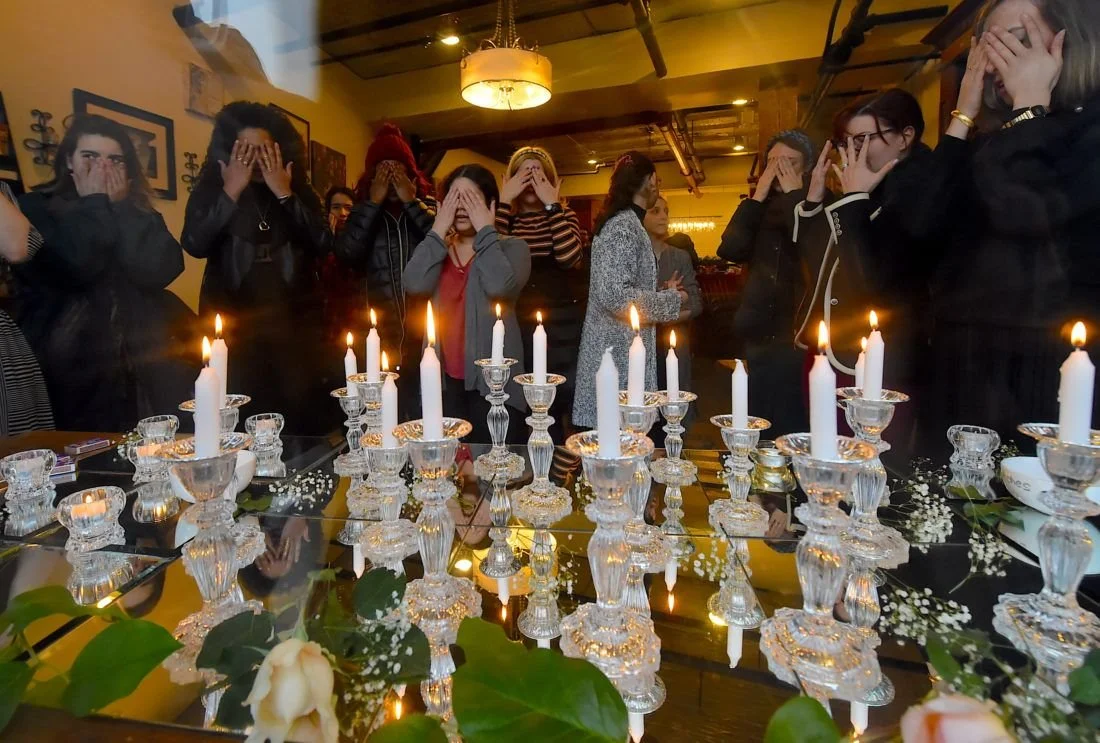
Women of Chabad of Bushwick light Shabbat candles in the very window of their synagogue that had been smashed by a bat-wielding attacker just one week earlier. Their act of rededication transformed a place of destruction into a symbol of Jewish resilience, faith, and light as they welcomed the Shabbat.
In the 1940s, the Previous Chabad Rebbe, Rabbi Yosef Yitzchak Schneersohn, began sending young rabbinical students, primarily during their summer vacation, to the far corners of the world to find isolated Jews and rekindle the spark in their souls. The Rebbe, Rabbi Menachem M. Schneerson, expanded this mission enormously. He established permanent Chabad centers around the globe and continued sending students to visit places that had no permanent Jewish presence at all.
One summer, two of these students traveled to a small town in northwestern Alaska. The mayor told them politely that, as far as he knew, there were no Jews in town; most residents were Yup'ik, an Alaska Native people. He did invite them to speak at the local school, though. The young rabbis taught a group of fourth- to eighth-graders a little about Judaism. The children performed traditional Yup'ik dances for their guests, and the two Rabbinical studends responded with a lively Chassidic dance of their own.
The Rebbe had asked them to find Jews wherever they could, so one of the students, Rabbi Berkowitz, asked the class, "Has anyone here ever met a Jew?"
A young Yup'ik girl raised her hand. "My mother," she said, and pointed to the fifth-grade teacher at the back of the room.
After class, the teacher came over, visibly moved. She had grown up in the lower forty-eight and had always loved the outdoors. Years earlier she had come to Alaska, fallen in love with a local man and made her life there. "Living out here," she said, "I don't know if my daughter will ever meet another rabbi. Please, give her a message she'll carry with her, so she'll always be proud to be Jewish."
Rabbi Berkowitz knew he had only a few minutes. He spoke to the girl about Shabbat, the holy day of rest. "And who brings Shabbat into the world?" he asked. "Jewish women and girls, when they light Shabbat candles. They bring peace and light into the world."
Then he asked her, "Where is the first place on earth where the sun sets on Friday?"
She knew her geography. "Probably New Zealand or Australia."
"That's right," he said. "Jewish women in New Zealand and Australia are the first to welcome Shabbat. Then come the candles in Asia, in Israel, in Europe, then New York, Chicago, Seattle and Anchorage. But even after all of them, there is still one place where the sun hasn't set yet: right here in Yup'ik country. After every mother and daughter around the world has lit, G-d and the Jewish people are still waiting for you, the last Jewish girl in the world, to light your Shabbat candles."
In G-d's eyes, every one of us is that girl. Each of us is of ultimate importance and infinite value, and the world is waiting for the light that only we can bring.
A Gathering of Emissaries
This week, I have the privilege of spending several days with more than 6,000 colleagues and friends from 111 countries at the annual International Conference of Chabad Shluchim (emissaries). It is part family reunion, part strategy summit and part spiritual recharge. We share ideas, face challenges together, explore new opportunities and draw strength from one another.
Above all, the conference reminds us of our mission. As the Rebbe's emissaries, we carry the flame of Judaism, the light of Torah and mitzvot, goodness and kindness to every corner of the world and prepare the world for the era of Moshiach.
Chayale and I feel deeply privileged to serve in this role, under the dedicated mentorship and leadership of Rabbi Benjy and Hinda Silverman. Together we are building a vibrant Jewish business community that supports thousands of Jewish professionals. We strive to enrich their careers and their material lives, and also strengthen their spiritual lives through connection, community and the timeless values of Jewish tradition.
Sarah's Light
In this week's Torah portion, Chayei Sarah, Isaac (Yitzchak) marries Rebecca (Rivka). A series of remarkable, even miraculous, events leads to their meeting. Then Isaac brings Rebecca into the tent of his mother Sarah, and he finds comfort after Sarah's passing:
"Isaac brought her into the tent of Sarah his mother, and he took Rebecca, and she became his wife, and he loved her. And Isaac was comforted after his mother." (Genesis 24:67)
Rashi (Rabbi Shlomo Yitzchaki, 1040–1105, Troyes, France) explains that Rebecca became like Sarah. While Sarah lived, three miracles graced her tent: the Shabbat candles burned from one Friday to the next, a blessing rested in her dough, and a cloud of the Divine Presence hovered over the tent. When Sarah died, the miracles stopped. When Rebecca arrived, they returned.
These three miracles correspond to the three mitzvot entrusted especially to Jewish women: lighting Shabbat candles, separating challah from the dough, and observing the laws of family purity, including immersion in a mikvah following the menstrual cycle. The fact that all three miracles were present in Sarah's home reflects her embodiment of these three foundational mitzvot and her role as the quintessential Jewish woman.
The three miracles also correspond to our basic human needs. Some needs are internal, like food, which the blessed dough represents. Others are external, like shelter and family, which the cloud over the tent represents. There is also a third need: light.
Turning on a light adds nothing physical to a room, yet it changes everything. Confusion, disorientation and gloom give way to clarity, direction and joy. Our spiritual lives work the same way. We can go through the motions of Jewish practice without warmth or vitality. The Shabbat candle stands for the third miracle: the ability to fill everything we do with enthusiasm and life. We earn that miracle through mitzvot and Torah study, especially the study of the Torah's inner dimensions.
This mitzvah was given especially to women because they have a unique power to bring warmth, clarity and true values into the home, family and community.
A Campaign of Light
In 1974, the Rebbe launched a worldwide campaign encouraging every Jewish woman and girl, from age three and up, to light Shabbat candles. The campaign breathed new life into this ancient mitzvah. Today, millions of Jewish women and girls light candles every Friday before sunset and bring G-dly light into a world that badly needs it.
The Zohar teaches that when a woman lights Shabbat candles with joy in her heart, she brings peace into the world, health and happiness to her family, and children who will brighten the world.
The Midrash promises, "If you keep the lights of Shabbat, I will show you the lights of Zion." Shabbat candles bring light and warmth into our homes, and the Redemption will bring that same light and warmth to the whole world. Every candle lit and every home filled with the peace of Shabbat brings us one step closer to the era that will be "entirely Shabbat and rest."
This Friday, let's encourage our family, friends, neighbors and coworkers to light Shabbat candles before sunset in merit of the safety of the brave soldiers of the IDF and of our brothers and sisters everywhere. May we soon see true peace and prosperity for every nation on earth, with the coming of Moshiach now!