Only You Can Light Your Own Candle
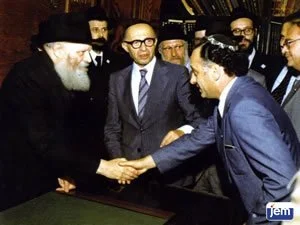
Israel's Ambassador Yehuda Avner greets the Lubavitcher Rebbe during a visit accompanying Prime Minister Menachem Begin, who looks on.
Before his historic first meeting with newly elected U.S. President Jimmy Carter in 1977, Israeli Prime Minister Menachem Begin asked Israel's ambassador, Yehuda Avner, to arrange a meeting with the Rebbe, Rabbi M.M. Schneerson in New York to receive his guidance and blessings. The Rebbe and Begin shared a close relationship and engaged in numerous discussions regarding the spiritual and security challenges facing the Jewish people and Israel.
Following Begin's meeting at the White House, Avner returned to the Rebbe to report on the discussions. What followed became one of the most memorable conversations of his life.
Late into the night, after nearly two hours of discussion, Avner turned to the Rebbe and asked a profound question:
"Rebbe, what is it that you seek to accomplish?"
The Rebbe pointed to a shelf across the room.
"Yehuda, what do you see there?"
"A candle," Avner replied.
"No," said the Rebbe. "It is merely a lump of wax with a string down the middle. When does that lump of wax become a candle? When a flame is brought to the wick."
The Rebbe continued:
"The wax is the human body, and the wick is the soul. The flame is the fire of Torah. When the soul is ignited by the flame of Torah, that is when a person becomes a candle, fulfilling the purpose for which he was created."
Then he added:
"This is what I try to do—to help every man and woman achieve the purpose for which they were created."
Hours later, as dawn approached and the meeting was coming to an end, Avner asked one final question:
"So, Rebbe, have you lit my candle?"
The Rebbe smiled gently and replied:
"No. I have given you the match. Only you can light your own candle."
The Menorah: A Symbol of Human Potential
This powerful exchange echoes one of the central themes of this week's Torah portion, Beha'alotecha, which begins with the commandment to light the Menorah in the Mishkan and later in the Holy Temple.
The Torah uses an unusual expression when describing the lighting of the Menorah. Rather than simply saying "when you light," it uses the word Beha'alotecha—"when you cause the flame to ascend."
Rashi, Rabbi Shlomo Yitzchaki (1040-1105 Troyes, France) explains that the priest was required to hold the flame to the wick until the fire burned independently and rose on its own. The goal was not merely to ignite the lamp, but to ensure that it could sustain itself.
The Menorah was never intended simply to provide physical illumination. Rather, it served as a source of spiritual light for the entire world.
Its message remains just as relevant today.
Becoming a Lamplighter
The Rebbe often taught that every person is called upon to become a "lamplighter."
King Solomon describes the soul as "the lamp of G-d" (Proverbs 20:27). Every individual possesses extraordinary potential, but potential alone is not enough. Like a candle waiting to be lit, it requires inspiration, guidance, and purpose.
Yet the ultimate goal is not dependence. Just as Aaron was instructed to kindle the Menorah until the flame could burn on its own, so too our responsibility when helping others is to empower them to become self-sufficient sources of light.
Whether as parents, educators, mentors, business leaders, or friends, our role is not merely to influence others temporarily. It is to help them discover their own strengths, talents, and purpose so that they can illuminate the world independently—and ultimately inspire others as well.
Seven Branches, One Menorah
Another remarkable lesson emerges from the Menorah's design.
The Menorah consisted of seven branches, each holding its own flame. According to Kabbalah, these seven branches correspond to seven primary emotional characteristics and seven general types of souls.
This teaches us an important truth: people are not meant to be identical.
Each individual has unique talents, perspectives, strengths, and contributions. Some are natural leaders, others builders, teachers, visionaries, creators, or caregivers. Diversity is not an obstacle to unity—it is part of the Divine design.
At the same time, the Torah emphasizes that the entire Menorah had to be fashioned from a single piece of gold.
While the branches were distinct, they were inseparable from one another.
The message is profound. We may differ in our backgrounds, personalities, professions, and paths in life, but we all originate from the same Creator and share a common purpose: to bring goodness, holiness, and light into the world.
In many ways, society resembles an orchestra. Each musician plays a different instrument and contributes a unique sound, yet together they create a beautiful symphony. The same is true of a successful team, a thriving business, or a healthy community.
Our differences are not what divide us; they are what allow us to contribute something uniquely valuable.
Bringing Light to the World
A candle does not lose its flame when it lights another candle. In fact, the light only increases.
The same is true in our personal and professional lives.
True growth is not measured solely by what we achieve for ourselves, but by how much light we bring to those around us. Success reaches its highest purpose when it enables us to elevate others, strengthen our communities, and contribute to a more moral and compassionate world.
Each Mitzvah we perform, every act of kindness, each word of encouragement, each lesson shared, and each opportunity created for another person becomes another flame added to the Menorah of humanity.
The challenge before us is not simply to grow ourselves, but to become sources of inspiration for others—to light our own candle and then help others discover the match within themselves.
Looking Toward the Future
The prophets envision a future in which humanity recognizes its shared purpose and unity under G-d. As Maimonides describes, “At that time there will be no famines and no wars, no envy and no competition. For the Good will be very pervasive. All the delicacies will be as readily available as is dust. The world will only be engaged in knowing G-d”
The Menorah reminds us that this future begins today—with each of us.
By embracing our unique gifts while recognizing our shared purpose, by lighting our own flame and helping others light theirs, we bring more light into the world and move one step closer to the fulfillment of creation's ultimate purpose with the era of Moshiach when the greatest light will be revealed!
May we merit to see that day very soon.