My Friend, the Grand Rebbe
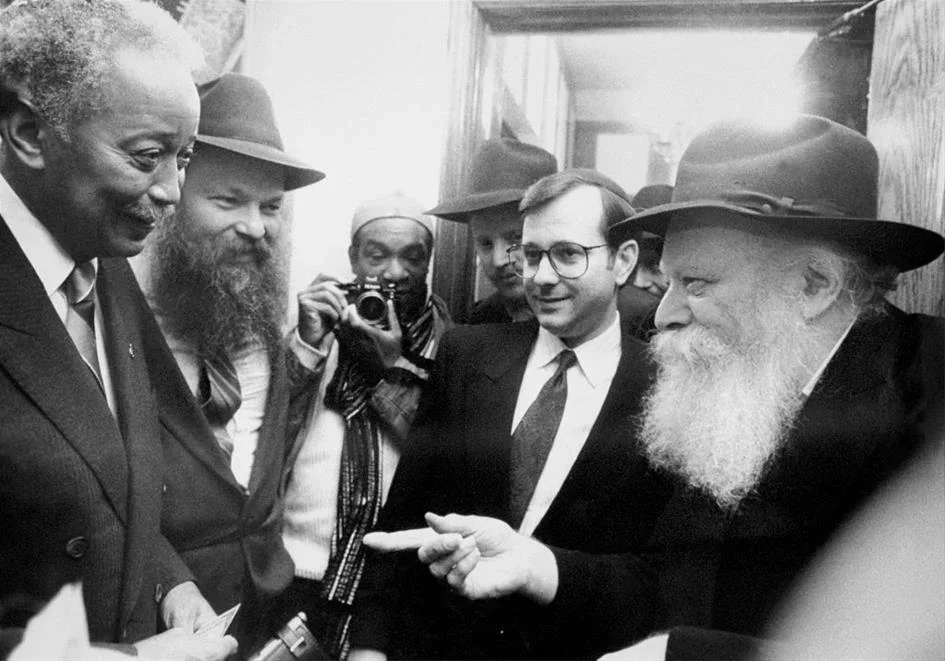
NYC Mayor Dinkins with the Rebbe
“When my brother, the late Councilman James E. Davis, and I were about ten and twelve years old,” Geoffrey Davis recalled, “we used to play in front of our home in the Crown Heights section of Brooklyn.
Every day, a kind, friendly man would walk past our house on his way home from the synagogue and stop to speak with us. We genuinely looked forward to seeing him, and he greeted us warmly. Sometimes he would even give us a dollar to pass along to charity.
He took the time to get to know us. He didn’t look like us, but he opened the door for us to communicate with and embrace all human beings. We were Christians; he was Jewish. We were Black; he was white. We were children; he was an elderly man. Every aspect of the relationship was unexpected.
Later, we discovered that this man was the Grand Rebbe, Rabbi Menachem M. Schneerson, a renowned world leader. But to us, he was simply our friend.
I vividly remember one afternoon when James and I were arguing aggressively over a ball. The Rebbe, already in his late seventies, walked over to intervene. He told us to behave and then said words that stayed with us forever: ‘Love your brother as you love yourself, and love yourself as you love your brother.’
He emphasized that although we were unique individuals, everything begins with learning to value yourself. Our entire career path was shaped by his presence and those simple yet profound words.”
Inspired by the Rebbe’s ability to see beyond social barriers, James Davis eventually entered public service and became a New York City Councilman. Together, the brothers founded the nonprofit organization Love Yourself, Stop the Violence to help combat inner-city crime.
“Looking back,” Geoffrey reflected, “it’s incredible. He was one of the most influential spiritual leaders in the world, yet to us he was simply a friend who cared enough to guide two neighborhood kids. He taught us how to communicate with and embrace all people, regardless of background.” (See here for video interview)
The Modern Crisis of “Not Enough”
The Rebbe’s message speaks directly to one of the deepest struggles of modern life: the feeling that we are never good enough.
Recent studies have shown that close to 80% of young adults battle feelings of inadequacy and constant pressure to measure up. In a world dominated by social media, competition, and nonstop comparison, people often tie their value to performance, status, or public image.
But the pressure is not only external—it is internal. In earlier generations, a tailor, grocer, or water carrier knew their role mattered to the community. Today, in an age shaped by globalization, AI, and automation, many people feel interchangeable and invisible.
The Torah offers a radically different perspective: our value is not determined by what we produce, but by who we are.
Counting Diamonds
Beginning in 1986, the Rebbe spent countless Sunday afternoons greeting, advising and blessings thousands of visitors from every walk of life. To each person—heads of state, business leaders, children, and ordinary individuals—he handed a dollar bill to give to charity.
His reasoning was simple: “When two people meet, something good should come from it for a third person.”
Once, an elderly woman asked how he managed to stand for so many hours without tiring. The Rebbe replied:
“Every soul is a diamond. Can one grow tired of counting diamonds?”
A diamond may be hidden beneath dirt or buried deep underground, but its essence remains precious and unbreakable. The task of life is not to create worth, but to uncover it.
There Is No Such Thing as a “Small” Person
This idea is expressed in this week’s Torah portion, Bamidbar, which begins with G-d’s command to Moses and Aaron to take a census of the Jewish people.
Of course, G-d did not need a census to know the population. Rashi explains that G-d counts the Jewish people repeatedly because they are precious to Him.
In a census, every individual counts equally as “one.” The greatest leader and the simplest laborer are both indispensable parts of the whole.
Counting something reflects value. By counting each person individually, the Torah teaches that every soul possesses inherent and immeasurable worth.
The simplest individual possesses a divine soul no less precious than that of Moses himself. When we truly internalize this idea, we begin to treat others—and ourselves—with greater dignity, patience, and compassion. When we recognize that we are important and our actions matter, we try to live up to our potential.
Shabbat: Rediscovering Who We Are
This message also connects to the timeless gift of Shabbat.
As part of Jewish American Heritage Month and America’s upcoming 250th anniversary, the White House recently encouraged Americans to observe a “National Sabbath,” this week, recognizing the Jewish tradition of dedicating time to rest, faith, gratitude, and reflection.
Shabbat reminds us that our identity is not defined solely by productivity. For one day each week, we step away from the constant pressure to produce, compete, and achieve. We reconnect with family, community, faith, and the divine image within ourselves.
It is a weekly reminder that our worth is inherent—not earned.
Celebrating the Beginning
This spirit of unity and reflection leads us into the upcoming holiday of Shavuot (beginning sunset on May 21 through May 23), commemorating the giving of the Torah at Mount Sinai over 3300 years ago. Each year, we reenact those very moments and listen to the Ten Commandments being read in synagogue and recommit ourselves to the values and timeless teachings of the Torah.
The Torah describes the Jewish people standing at Sinai “like one person with one heart.” Every individual mattered. Every soul was present.
Before Shavuot in 1986, the Rebbe encouraged Jews of all backgrounds—men, women, and children—to gather together in unity on the Shabbat before Shavuot each year, just as our ancestors did before receiving the Torah.
Maimonides teaches that every person should view the world as perfectly balanced between merit and deficiency, and that one good deed can tip the scale and bring Redemption for all humanity.
This Shabbat, let us rediscover the “diamond within” ourselves and others. Let us recognize that every individual has a unique mission and irreplaceable value.
And may our collective acts of goodness, unity, and faith help prepare the world for the era of redemption—a time of peace, purpose, and divine awareness for all humanity.