I Kept My Freedom in Hamas Captivity
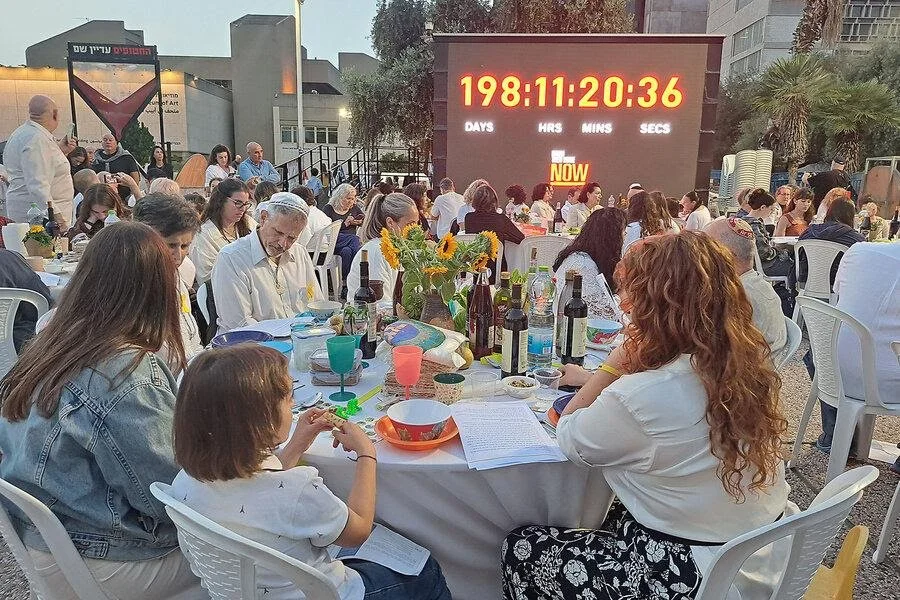
The Pesach Seder prepared in Tel Aviv's Hostage Square
In a powerful essay published by The Wall Street Journal, titled “I Kept My Freedom in Hamas Captivity,” former hostage Agam Berger shares her extraordinary reflections on endurance, faith, and the meaning of Passover during her months of captivity in Gaza.
“When Hamas overran our base on October 7, many of my friends were murdered,” Berger writes. “In those harrowing moments, as I was being kidnapped, I had the freedom to choose what to say. I recited, over and over, the same verse that Jews on the threshold of death have whispered for generations: Shema Yisrael, Hashem Elokeinu, Hashem Echad — 'Hear, O Israel, the Lord is our God, the Lord is One.'”
Even in the depths of captivity, Berger experienced what generations of Jews have long understood: no physical chain can imprison the Jewish soul. Despite brutal attempts by her captors to force her into abandoning her identity, her faith in G-d and her commitment to her heritage remained unbroken. “Our faith and covenant with G-d, the story we retell each Passover, is more powerful than any cruel captor,” she wrote.
“I chose to observe every Jewish fast possible. My captors found religious texts among newspapers and maps left in the field by IDF soldiers and brought them to me, trying to learn any information and Hebrew they could. They eventually abandoned a siddur, a Jewish prayer book, for which I fashioned a protective case out of the leg of a tattered and unwearable pair of pants. I kept kosher, which at times meant refusing non-kosher meat when I was hungry. I chose not to light a fire on Shabbat to cook for my captors.”
“My fellow scout Liri Albag and I marked Passover together last year. Held in a small room with no natural light, we did what we could to set the holiday mood. We cleaned our room and adorned the table with napkins and other small “decorations” made from scraps of paper. As a surprise, Liri wrote me a makeshift Passover Haggadah, the text that recounts our ancestors' journey out of slavery. Throughout captivity we were moved from tunnels to apartments and, in some, had limited access to television and radio. On Passover we heard that people had set us a table in Hostage Square in Tel Aviv. Liri listened to her mother's voice on the airwaves. We cried, then sat down to eat our own “bread of affliction,” the Haggadah's description of the matzah our fathers ate in Egypt. Our corn flour pitas united us with them.”
When she was finally freed on January 30, Berger wrote, “I chose the path of faith, and with the path of faith I have returned.” She believed throughout her ordeal that she would return home whole.
Berger explains that in the Book of Exodus, G-d promises four expressions of redemption which we commemorate through the four cups of wine during the night of the Seders: “I will take you out,” “I will save you,” “I will redeem you,” and “I will take you as Mine.” But she also reminds us of the fifth: “I will bring them back” — a prayer for the safe return of every hostage to their families, their people, and their Creator.
This fifth expression, which is represented by Elijah's cup on the night of the Seder, represents the collective Redemption of the Jewish people from the current exile as we anticipate the coming of Moshiach!
Agam Berger and her fellow freed hostages refuse to let their suffering define them. Instead, they have emerged as powerful symbols of resilience and unshakable faith, inspiring countless Jews and non-Jews around the globe.
In the wake of the October 7 massacre — the most brutal assault on the Jewish people since the Holocaust — one might have expected the Jewish spirit to fracture under the weight of grief and loss. And yet, the opposite has happened. Across Israel and Jewish communities worldwide, amid pain and uncertainty, we have witnessed an extraordinary resurgence of unity, faith, and strength.
While we mourn the lives that have been lost and pray daily for the safe return of all hostages — and for the safety of our brothers and sisters in Israel and around the world — we must also recognize that the most powerful answer to antisemitism has always been, and continues to be, a deepening commitment to Jewish identity, heritage, and community.
Hamas, Hezbollah, the Houthis, Iran, and their terrorist proxies — along with antisemites across history — have shared the same goal: the erasure of Jewish life. Our response must be the exact opposite. We must raise proud Jewish families, engage deeply with Torah and mitzvot, and to strengthen our connection with our faith and community.
The Haggadah reminds us of this enduring truth:
“In every generation, they rise against us to destroy us, but the Holy One, Blessed be He, saves us from their hands.”
Passover teaches us not only to recount the past but to build the future. The Seder begins with memory — retelling the Exodus from Egypt — but the festival's closing days shift toward hope for ultimate redemption. The seventh day marks the miraculous splitting of the Sea of Reeds, the moment when the Jewish people severed their final ties to slavery and stepped fully into freedom. This teaches us that true liberation requires more than escape from oppression; it demands the courage to embrace a new identity and a sacred future.
This is the challenge of every generation — including our own. Moments of inspiration must give rise to action. Without action, hope fades and old patterns return. Real freedom, both national and personal, comes only through conscious, ongoing commitment: learning from the past, living with purpose in the present, and building toward the future.
Since October 7, the Jewish world has seen the flames of identity, faith, and unity rekindled. If we want this awakening to last, we must channel this collective strength into Torah study, mitzvah observance, and inspiring our children to embrace their heritage proudly and joyfully. We transform tragedy into purpose, and grief into lasting strength.
The message of Passover points beyond personal redemption toward global transformation. On the eighth day of the festival, we read from the prophet Isaiah, envisioning a world of peace:
“The wolf will dwell with the lamb; the leopard will lie down with the young goat.” (Isaiah 11:6)
As Maimonides explains, this prophecy anticipates a future where all nations will coexist in harmony — a world redeemed and at peace.
The Baal Shem Tov taught that the final day of Passover holds a special light — the light of future Redemption. He established the tradition of Moshiach's Seudah, a special meal held in the holiday's closing hours, complete with matzah, wine, Torah insights, song, and dance. It mirrors the Seder but shifts the focus from the Exodus past to the Redemption still to come.
May we merit to celebrate Moshiach's Seudah together this year — in Jerusalem — with the arrival of the final Redemption.