Finding Community in a Bomb Shelter
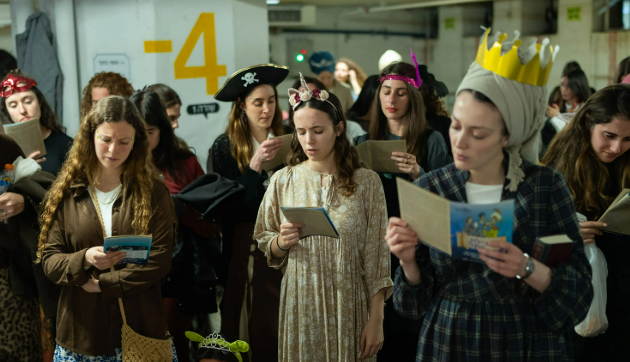
One of the many Purim celebrations and Megillah readings held in bomb shelters across Israel
A few hours before the start of Purim this week, I received a call from a member of the JBN community. He and his family were in Israel for an extended stay and suddenly found themselves in the midst of war. Air raid sirens had been sounding regularly, forcing them in and out of bomb shelters throughout the day.
Because of the security situation, he was unable to go to synagogue to hear the reading of the Megillah. Yet Purim had already begun in Israel, and he was determined not to miss the mitzvah.
He had a kosher Megillah scroll with him, but he needed help reading it properly. Jewish law requires that the Megillah be heard live in order to fulfill the mitzvah—it cannot be done over Zoom or a recording. So we found a creative solution: I read the Megillah aloud, and he repeated the words as he read from his scroll.
But he didn't stop there.
Realizing that others in his building might also appreciate the opportunity, he quickly invited his neighbors to join. Some of them he had only recently met while sitting together in the bomb shelter during the sirens. Many described themselves as secular Jews and had not planned on participating in a Megillah reading that evening.
Yet when they were invited, many expressed appreciation—and several came to join.
What emerged was a remarkable scene. In a small apartment in Israel, neighbors from different backgrounds gathered together to hear the Megillah and recount the miracles of the Purim story.
What made the moment especially meaningful was not only the mitzvah itself, but the people who came together to share it.
In times of crisis, labels tend to fade. The neighbors who had met only hours earlier in a bomb shelter suddenly discovered something deeper that connected them. They may have grown up with different levels of observance and very different experiences of Jewish life, yet in that moment they were simply Jews sharing a sacred tradition.
Our enemies recognize this reality all too clearly. They do not distinguish between religious or secular, observant or not. In their eyes, a Jew is a Jew.
Ironically, they often recognize a truth that we sometimes forget ourselves: that every single Jew matters.
The Purim gathering in that apartment captured that truth. Friendships that began in a shelter during moments of fear transformed into a moment of connection, tradition, and shared identity.
The Purim story itself carries a similar message. The villain Haman plotted to destroy the Jewish people in a single day—every man, woman, and child, without distinction. His decree did not target only the observant or the scholars; it targeted every Jew.
And in response, the Jewish people stood together as one. As Mordechai declared, “Go and gather all the Jews.” In moments of challenge, the Jewish people have always rediscovered that our divisions are often superficial. Beneath the surface, we share a deep and unbreakable bond.
In every generation, new enemies arise with similar intentions. Today, the modern-day Hamans of Iran openly threaten to wipe Israel off the map. Yet history repeatedly shows that attempts to destroy the Jewish people often have the opposite effect—they remind us of our shared identity and strengthen our unity.
If our enemies recognize the significance of every single Jew, regardless of religious affiliation or level of observance, then surely we must recognize and appreciate that truth as well.
This idea also appears in this week's Torah portion, Ki Tisa, in the story of the Golden Calf.
Less than forty days after hearing the Ten Commandments directly from G-d at Mount Sinai, the Jewish people made a grave mistake. Moses had ascended the mountain for forty days and nights to study the Torah from G-d so that he could later teach it to the people. When Moses did not return at the time they expected—due to their mistaken calculation—some of the people panicked and created a golden calf as a substitute for their leader.
When Moses descended from the mountain and saw the people dancing around the idol, he shattered the tablets engraved with the Ten Commandments and destroyed the calf.
G-d proposed destroying the Jewish nation because of their betrayal. But Moses intervened with extraordinary devotion. He declared to G-d: “If You do not forgive them, blot me out from the book that You have written” (Exodus 32:32).
Moses was willing to be erased from the Torah itself if the Jewish people were to be destroyed.
At first glance, the story seems to highlight the failure of the people. Yet Moses' response reveals something much deeper—the profound value of every individual Jew.
Our sages teach that although G-d is united with the Torah, His connection with the Jewish people is even deeper. In fact, the Jewish people preceded the Torah in creation. Moses understood that his mission as a true leader and teacher of the Torah only had meaning if the Jewish people themselves remained.
Rashi explains that Moses shattered the tablets partly to protect the people from liability. If G-d were to accuse them of violating the commandments, Moses could argue that they had not yet formally received the tablets and therefore were not yet bound by them.
But the deeper message is even more powerful.
The bond between the Jewish people remains intact even when individuals falter in their connection to Torah. As the Talmud famously teaches: “Even when a Jew sins, he still remains a Jew.”
That is why Moses was prepared to sacrifice his own place in the Torah for the sake of his people—all of his people, even those who had worshipped the Golden Calf.
This teaches us an important lesson. The intrinsic value of a Jew is not determined by their level of observance. Every individual carries an inherent divine spark and an indispensable place within the Jewish people.
For us today, the lesson is clear. It is not enough simply to fulfill the commandment to “love your fellow as yourself.” We must also recognize the intrinsic worth and potential within every Jew and create opportunities for connection.
Sometimes that begins with a simple invitation.
Invite a neighbor for a Shabbat meal. Offer someone the opportunity to put on tefillin. Light Shabbat candles. Affix a mezuzah. Share a Torah insight with a colleague. Perform a random act of kindness for a stranger.
Small gestures can open doors to connection and belonging.
Our sages teach that in the future redemption, no Jew will be left behind. The goodness and holiness within every person will ultimately come to the surface.
And sometimes, that process begins in the most unexpected places.
Let us each take on an extra mitzvah and recite an additional prayer for the safety of our brothers and sisters in Israel, for the soldiers of the IDF and the U.S. armed forces, and for all those who place their lives on the line to defend freedom, eradicate evil and protect the lives of so many.
Through acts of goodness, unity, and faith, may we help bring greater peace and blessing to the world—and may we soon merit the ultimate redemption, with a time of lasting peace in Israel, the Middle East, and throughout the world.