Coming Home: A 9/11 Story
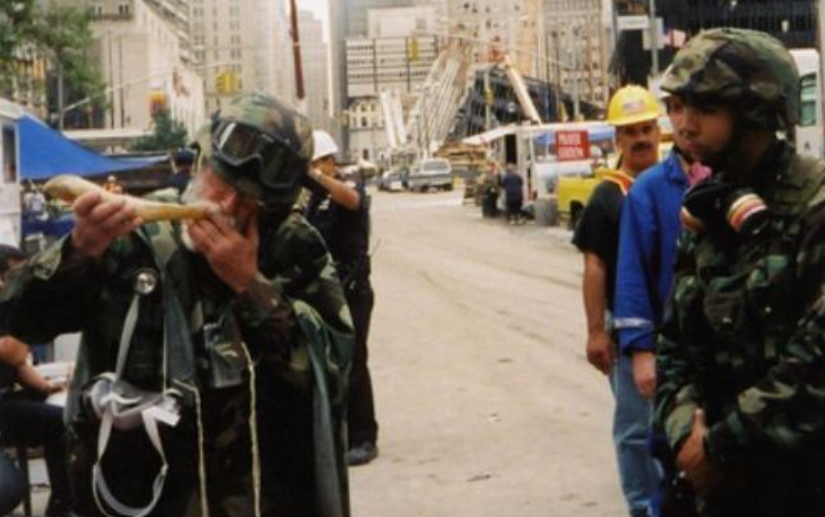
Col. Goldstein, Chief Chaplain of Ground Zero, blows the Shofar in the aftermath of 9/11
Despite the horrific devastation of September 11, 2001, glimmers of light and small miracles emerged—quiet reminders that no matter how dark or challenging a situation may seem, purpose can always be found.
On the morning of 9/11, just one week before Rosh Hashanah, Rabbi Leivi Sudak, a Chabad emissary in the U.K., boarded a flight from London to New York. When American airspace was sealed shut, his plane was diverted to Gander, a small town in Newfoundland, Canada with a population of 9,000. Stranded alongside 38 other planes carrying 6,700 passengers from 95 countries, Rabbi Sudak held fast to a central teaching of the Baal Shem Tov: wherever a person is led, it is by Divine providence. There are no accidents.
"Throughout this experience, I kept asking myself, 'Why am I here? What is the purpose of all this?'" he later recalled. Over the next few days, his questions were answered through encounters carrying a quiet message: no matter how far we wander, what we look like, or how much has changed, we can always find our way back.
The people of Gander opened their schools, community centers, and homes. Residents cooked around the clock to feed their unexpected guests, turning their quiet town into a beacon of warmth.
Rabbi Sudak was housed in a local school alongside 500 other evacuees. He was given access to a staff room with a stove and cooktop, which he made kosher by purchasing new utensils and kosher ingredients. He prepared kosher meals not only for himself but also for the few dozen other Jewish people stranded with him. He even went a step further, preparing vegetarian and halal meals for those with other dietary needs.
Each day, as is customary during the month of Elul leading up to Rosh Hashanah, the sound of the shofar rang through the corridors—a piercing, ancient cry rising through grief to call people back to something essential.
Among those Rabbi Sudak met was Ed Brake, an elderly local resident and Holocaust survivor who had not lived openly as a Jew in decades. As a child in Nazi Germany, his parents had sent him and his brother to live with a British family in Newfoundland, warning them never to reveal their heritage. Ed kept that promise his entire life—even from his own family.
Hearing a rabbi was in town, Ed asked to meet him. Their quiet interaction—which later inspired a central scene in the Tony Award-winning Broadway musical Come From Away—brought a moment of profound restoration. When Ed tried to return a yarmulke the rabbi gave him, Rabbi Sudak warmly gestured for him to keep it, signaling that the Jewish community had never left him. When Rabbi Sudak returned to England, he sent Ed a yarmulke, a tallit, and a siddur. Years later, Ed's son shared that before his father passed away, he asked to be buried with those sacred gifts. After a lifetime in hiding, Ed Brake came home.
Faith also revealed itself in unexpected places during a community Shabbat service Rabbi Sudak hosted. Among those attending was a Tibetan monk who turned out to be a descendant of an old Jerusalem family. The monk asked to recite Kiddush and help prepare the food. Though his outer life seemed entirely separate from his roots, when Shabbat arrived, he knew the words by heart. He, too, was coming home.
"What's most important here is the enormous kindness of these people at a time when the world was in absolute turmoil," Rabbi Sudak noted. "It teaches us that in spite of the darkness around us, we can still care and look after one another."
This message lies at the heart of Rosh Hashanah. The shofar represents the essential, wordless cry of the soul yearning to reconnect with G-d. It is raw and unpolished because the truest homecoming doesn't require eloquence—it only requires the longing to return.
The Baal Shem Tov told a parable which expresses this point:
A king once sent his only son to a distant land to learn and experience the world. He gave him great wealth, but the son eventually squandered it all and was left destitute. After many years, he finally returned to his father’s palace.
But he had forgotten his native language, and he looked nothing like the prince, so the guards refused to let him in. In despair, he cried out. The king, recognizing his son’s voice, ran to him, embraced him, and brought him home.
The king represents G-d, and the son represents each of us, the “children of G-d” (Deuteronomy 14:1). Our souls are sent into this world to transform it through Torah and mitzvot. Yet along the way, we can become distant and even forget our mission and spiritual language.
On Rosh Hashanah, we want to reconnect with G-d and our Jewish heritage, but sometimes we feel too distant or unsure of how to begin. So we sound the shofar—a simple, wordless cry from the depths of the soul.
The shofar expresses our longing to return home, our regret for the past, and our determination to move forward. Like the king who recognized his son’s cry, G-d hears the deepest voice within each of us and welcomes us home and gives us a good year.
We may have wandered far, but we are never too far from home.
Our Prophets teach that when Moshiach arrives, the Great Shofar will sound to gather the Jewish people from every corner of the earth back to the Land of Israel:
"And it shall come to pass on that day, that a great shofar shall be sounded, and those lost in the land of Assyria and those exiled in the land of Egypt shall come, and they shall prostrate themselves before the Lord on the holy mount in Jerusalem." — Isaiah (Yishayahu) 27:13
While the annual shofar of Rosh Hashanah calls the individual soul to awaken and return, this ultimate blast will be a global signal of total redemption. It will reach those who feel completely lost or distant, gathering everyone home to Jerusalem.
May this Rosh Hashanah find us making our way back—to our truest selves, to one another, and to G-d. May the sound of the shofar carry our longing heavenward, and may the new year bring blessing, good health, and peace to all.
May you be inscribed and sealed for a good and sweet new year!