A Transformative View on Feminism
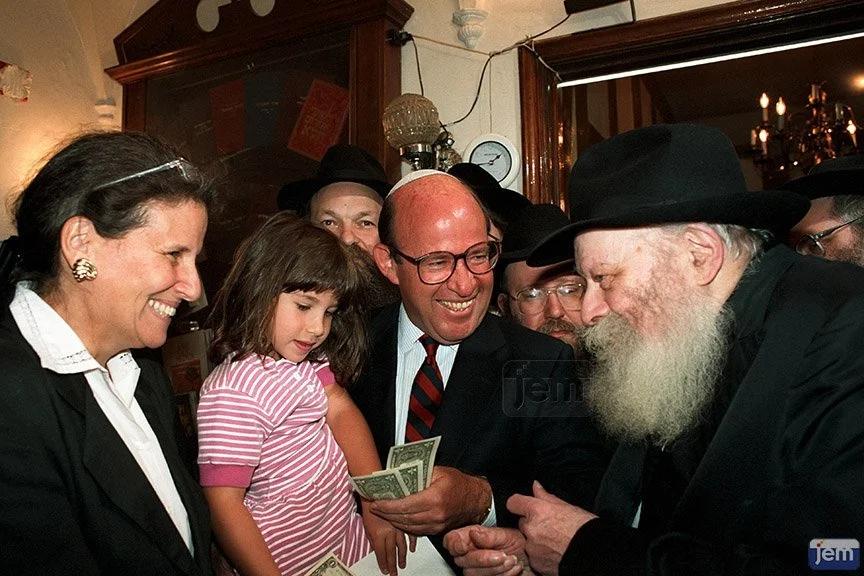
"When standing before him, you felt that you were the only person in the world."
— Mrs. Diane Abrams on the Rebbe
In the early 1970s, Diane Abrams was already breaking barriers. An accomplished attorney, she taught the nation's first "Women and the Law" course at NYU while her husband, Robert Abrams, was serving as NYS Attorney General. Yet despite her professional accomplishments, one of the most significant influences on her life came through her relationship with the Lubavitcher Rebbe, Rabbi M.M. Schneerson, which began in 1974.
What impressed her most was the Rebbe's extraordinary ability to see the individual. He took a genuine interest in her thoughts, aspirations, and contributions. Diane later recalled that standing before the Rebbe felt as though she were the only person in the world.
The Rebbe recognized something in her that many leaders overlook: her unique voice. He encouraged her to write about her family's story, ultimately inspiring her to publish My Grandmother's Candlesticks. More importantly, he encouraged her to appreciate the value of her own experiences and perspectives.
Diane was particularly struck by the Rebbe's approach to women's leadership.
While many discussions of feminism focused on achieving sameness between men and women, the Rebbe emphasized something different. He believed that equality did not require imitation. Women did not need to become copies of men in order to be valued or influential. On the contrary, he taught that women possess unique strengths and responsibilities that are essential to Jewish life and continuity.
The Rebbe strongly advocated for women's Torah education and encouraged women to assume leadership roles within their communities. Yet he rejected the notion that true empowerment comes from erasing distinctions between men and women. Instead, he taught that genuine empowerment comes from embracing and developing one's unique G-d-given qualities.
Diane experienced this firsthand. During one audience, her husband was discussing a communal issue and seeking the Rebbe's guidance. The Rebbe suddenly turned to Diane and asked for her opinion. "We are in the period of women's liberation," he remarked. "You must have a view. What's your opinion on the issue?" The Rebbe was not interested in hearing her husband's perspective alone. He wanted to hear hers.
This approach reveals a profound lesson about leadership. The Rebbe did not ask, "Can this person become a leader?" Rather, he asked, "How can this person use their unique gifts to influence others?" His goal was not to make people identical. His goal was to help each person discover and express their own distinct mission.
This idea sheds new light on the central conflict in this week's Torah portion, Korach.
Korach challenged the leadership of Moses and Aaron, declaring: "The entire congregation is holy, and G-d is among them. Why do you elevate yourselves above the assembly of G-d?" (Numbers 16:3).
At first glance, Korach's argument sounds compelling. After all, he was correct that every Jew possesses inherent holiness. Every person contains a Divine spark. Why, then, should one individual occupy a position of leadership over others?
The flaw in Korach's argument was not his belief in equality. It was his misunderstanding of individuality.
Korach assumed that if everyone is equally holy, everyone should occupy the same role. He viewed distinctions in responsibility and leadership as unfair. But Judaism teaches that equality does not mean sameness.
G-d created a world filled with diversity. Some people are teachers, others are students. Some are leaders, others are advisors. Some mitzvot apply specifically to Kohanim, others to Levites, and others to every Jew. Men and women each have unique responsibilities and opportunities. These differences do not diminish anyone's value; they reveal the richness of G-d's design.
As the Rebbe explained, we are all holy, but we are not all the same. Every individual possesses unique talents, strengths, and opportunities. True unity is achieved not when distinctions disappear, but when every person contributes their unique gifts toward a common purpose.
Korach's mistake was attempting to create unity by erasing differences. Moses, by contrast, understood that genuine unity emerges when each individual fulfills his or her unique mission.
This is also the essence of true leadership.
A leader does not create followers; a leader helps others discover their own potential. The Rebbe once compared this process to connecting a lamp to a powerhouse. Every Jewish soul is already connected to the Divine source. The challenge is simply to find the switch that allows the light to shine.
The task of a leader is to help people find that switch within themselves.
That is precisely what the Rebbe did for Diane Abrams and for millions of others. He did not ask her to become someone else. He did not encourage her to imitate others. Instead, he helped her recognize the significance of her own voice, her own talents, and her own mission.
The same lesson applies to each of us. Whether as parents, educators, employers, community members, or friends, we all have opportunities to lead. The most effective leadership is not about creating uniformity. It is about helping others discover the unique contribution that only they can make.
Yesterday marked the yahrzeit (anniversary of passing) of the Rebbe on the Third of Tammuz. The Talmud teaches, “Jacob did not die… just as his children are alive, so too is he alive” (Taanit 5b). The Rebbe's presence and influence is very much alive—seen in the revival of Jewish life after the Holocaust, reflected in the millions of Jews who are reconnecting to their Jewish heritage, and in the moral awakening of people across faiths through the Rebbe's call to disseminate the teachings of the Seven Noahide Laws relevant to all people.
The Rebbe embodied that vision throughout his life. He saw greatness in people before they saw it in themselves, and he inspired them to express the unique gifts with which G-d had entrusted them.
When we recognize and celebrate those differences, we create not division but unity, a unity built upon the harmony of many unique individuals working together to fulfill a shared Divine purpose.
From his very first public address, the Rebbe consistently emphasized the unique responsibility and opportunity of our generation. He empowered each individual to take personal initiative in bettering the world through increasing Torah study, observance of mitzvot, and acts of kindness. The Rebbe taught that we are living in a time of extraordinary spiritual potential—the final generation of exile and the first of Redemption. He urged us to view world events not as random occurrences but as part of a divine process preparing the world for the coming of Moshiach.
In 1991, a CNN reporter asked the Rebbe, “What is your message to the world about Moshiach (the Messiah)?” The Rebbe replied:
“Moshiach is ready to come now. We all must only do something additional in the realm of goodness and kindness.”
The tools are in our hands; the mission is nearly complete. Now is the time to bring the vision to fruition.