A Seder in Boquete
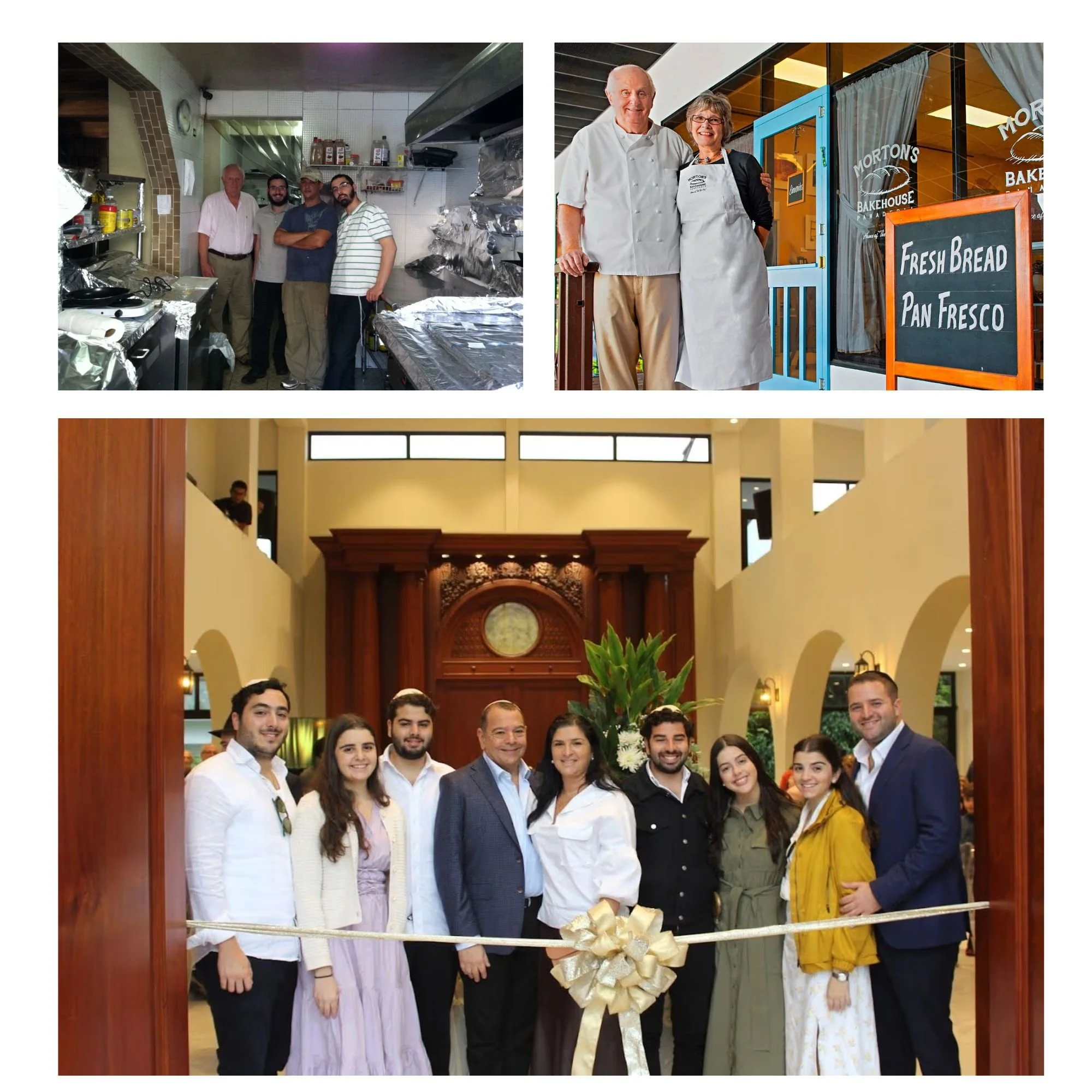
Top Left: Rabbis Leibel Greenbaum and Levi Levitin kashering the restaurant alongside Morton Rabkin and Craig Jacobs in 2012.
Top Right: Morton and Barbara Rabkin in front of Morton's Kosher Bakehouse.
Bottom: Community members at the ribbon-cutting ceremony for the new Chabad Center of Boquete in 2017.
Tucked high in the misty mountains of Boquete, Panama—the region’s coffee capital—a traveler might expect little more than quiet villages and picturesque landscapes. It is the kind of place people come to disconnect. Yet, unexpectedly, it has become a place where Jewish life flourishes.
I had the privilege of experiencing this firsthand in 2012.
A friend and I joined the Chabad Merkos Shlichus “Roving Rabbis” program, which sends young rabbinical students on missions to remote locations around the world to support Jewish communities without permanent infrastructure. Our assignment was Panama, where we were tasked with organizing a Passover Seder for locals and travelers.
When we contacted Chabad of Panama City, we were told about a small mountain town called Boquete. We were given little more than a contact—Morton & Barbara Rabkin, Jewish American retirees who had made Boquete their home—and encouraged to explore the opportunity.
When we reached out, we discovered that a Seder was already being planned for more than 50 people. Local Jewish expats, tourists, and travelers from around the world were expected to attend. We were warmly invited to join.
There was just one complication: the event was scheduled to take place in a local restaurant that was not Kosher.
We contacted the restaurant owner, Craig Jacobs, a Jewish native of New York. To our surprise, he was not only open to the idea of making the Seder fully Kosher—he was enthusiastic. His only request was to preserve the quality of his restaurant. He asked that we provide specific high-quality kosher cuts of meat and fish to replace his planned menu.
We agreed, importing everything in advance to meet his standards. Craig invited us to kasher the restaurant for Passover. He later told us that he had been asking around for a rabbi to lead a Seder, but had not been able to find one.
The day before Passover, we arrived with new pots, blowtorches, tools, utensils, and carefully prepared provisions to kasher the restaurant. As we worked, Craig casually mentioned something that he had never celebrated his Bar Mitzvah.
What followed was unforgettable. Right there in the restaurant, Craig put on tefillin for the first time in his life. What began as a logistical preparation became a deeply personal milestone, marked with a small but heartfelt celebration.
The following night, the room filled beyond expectation. People from all walks of life gathered around the Seder table. One by one, participants introduced themselves and shared personal reflections and journeys.
When it was Craig’s turn, he spoke with emotion. He described what it meant to host what would become the first public kosher Seder in Boquete. He spoke about his Bar Mitzvah experience, about transformation, and about leaving his own personal “Egypt.”
His words resonated deeply.
Spontaneously, the room erupted into a joyous chorus of “Siman Tov U’Mazel Tov.” Singing turned into dancing, and the energy carried late into the night—long after the formal Seder had ended.
A Flourishing Jewish Presence
Fast forward to today, and Boquete is now home to a vibrant, beautiful full-time Chabad Jewish Center, complete with a synagogue, kosher dining options, Jewish programming for all ages, guest accommodations, and even a state-of-the-art mikvah. Especially heartwarming is the Morton’s Kosher Bakehouse, a Jewish artisan bakery nestled in the lush coffee-growing highlands founded by my friend Morton Rabkin. What began as a one-time gathering has evolved into a sustainable and growing Jewish presence.
Boquete’s story reflects a much larger trend.
The Rise of Kosher Worldwide
Over the last few decades, the kosher food industry has evolved into a multi-billion-dollar global enterprise, with a significant portion of supermarket products now carrying certification. This growth is visible worldwide: travelers can enjoy kosher meals at the Grand Hyatt Baha Mar in the Bahamas or in major airport lounges. Notably, the Armani/Kaf in Dubai’s Burj Khalifa serves as the first certified Glatt Kosher restaurant in the tower. From university dining halls to major global brands, the demand for kosher certification continues to expand into the mainstream.
Keeping kosher has never been more accessible.
The Hebrew word kosher means “fit” or “proper,” referring to foods that meet the standards of Jewish dietary law. In this week’s Torah portion of Shemini, the Torah outlines the identifying signs of kosher animals:
“Any animal that has a cloven hoof that is completely split and brings up its cud… these you may eat… And anything in the water that has fins and scales…” (Leviticus 11:2–3, 9)
Animals such as cows, sheep, and goats are kosher; fish with fins and scales such as salmon and tuna are Kosher. If an animal lacks even one of these signs, it is not kosher.
More Than a Diet: A Way of Life
While Kosher is sometimes associated with health and sanitary benefits, its true meaning transcends human understanding. At the same time, it offers profound insights into how we live our lives.
Nachmanides explains that the food we consume becomes part of who we are—both physically and spiritually. The qualities of what we eat can shape our inner character and moral sensitivities.
In this way, the Torah’s dietary laws are not only about physical consumption, but also about refining the soul and cultivating a more sensitive and ethically attuned character.
Much like a specialized diet that addresses specific allergies or needs, Kashrut serves as a guide for the Jewish body and soul.
Kabbalistic teachings add that everything in the world contains a divine spark. When we use something for a higher purpose—through mindful eating or acts of kindness—we elevate that spark.
The signs of kosher animals themselves carry symbolic meaning. The requirement that an animal chews its cud teaches the importance of reflection. Before we act, speak, or decide, we are encouraged to pause and consider:
Is this aligned with who I am? Will this elevate myself and those around me?
Small Steps, Lasting Impact
Living a more mindful, kosher lifestyle does not require drastic change overnight. It can begin with simple, intentional steps:
Choosing kosher-certified products when shopping
Dining at kosher establishments when possible
Hosting a Kosher Shabbat Dinner with family and friends
Taking steps to Kasher our own homes
Each step brings greater alignment between our actions and our values.
From Boquete to the Bigger Picture
The story of Boquete is more than a travel anecdote. It is a powerful reminder that Jewish life can take root anywhere—even in the most unexpected corners of the world—and transform both people and places.
From a small mountain Seder to a thriving community, Boquete reflects a timeless truth: when given the opportunity, even the most distant places can become centers of connection, growth, and meaning.
Remarkably, our Sages teach that in the future Messianic era, even the pig—long seen as the epitome of non-kosher—will become kosher. As the Midrash says:
“Why is the pig called chazir? Because in the future, G-d will return (le-hachazir) it to Israel.”
When negativity is removed from the world, even the pig will have both kosher signs. It’s a reminder that ultimate transformation is possible—even for what seems permanently unclean.
May we merit to see that day soon, when peace, goodness, and G-dliness fill the earth with the coming of Moshiach.