A Nation of Lions: The Miracle of FlyDubai Flight 1073
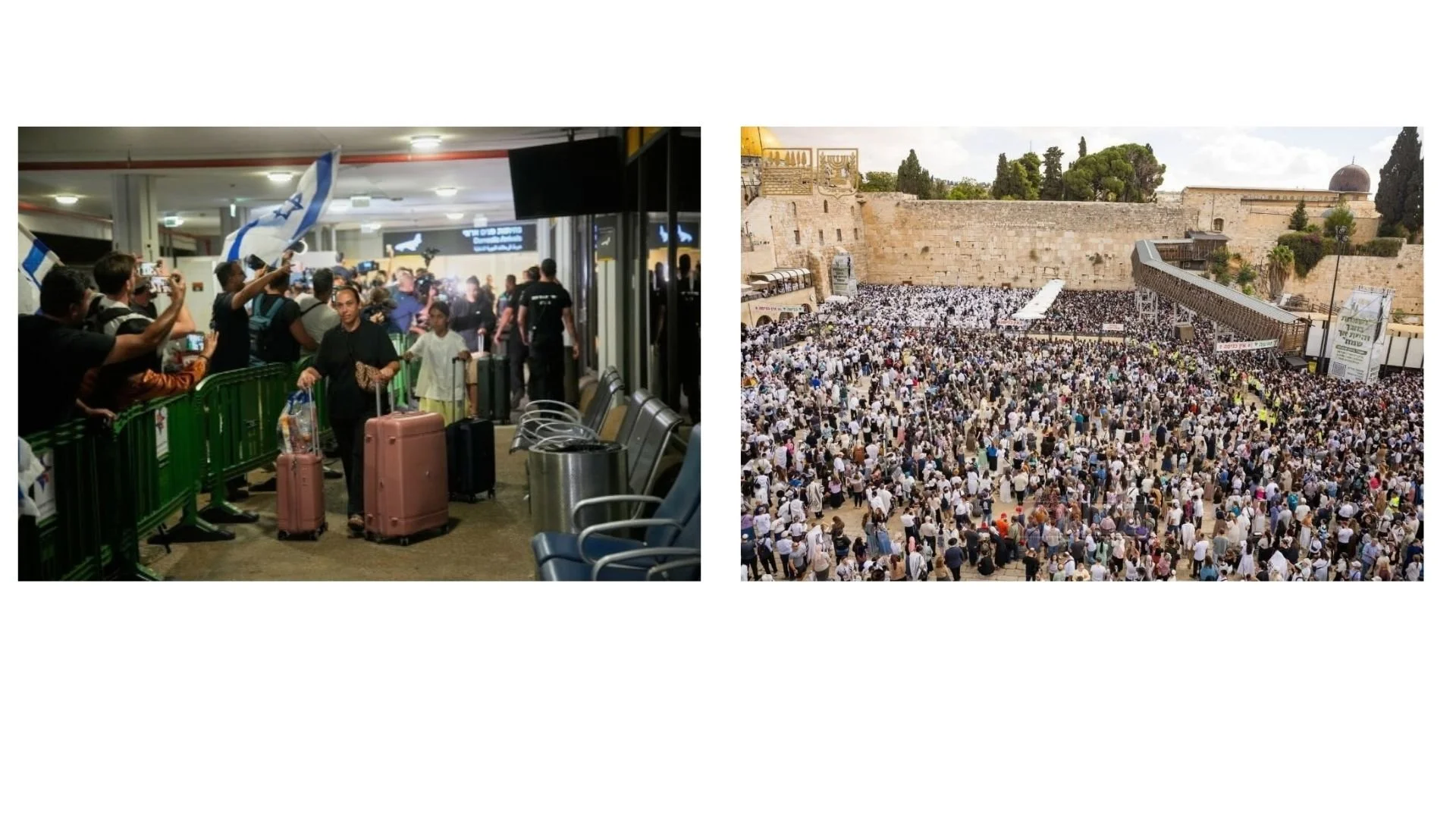
Left: Family and friends celebrate as Flight 1073 lands safely in Israel
Right: Tens of thousands gather at the Kotel to give thanks and celebrate the Miracle
Earlier this week, Flydubai Flight 1073, en route from Dubai to Tel Aviv, became the scene of an extraordinary mid-air crisis. The co-pilot—an Omani national—violently attacked the Indian captain, Smit Machchhar, with an axe, then seized control and forced the aircraft into a steep dive. In just 35 seconds, the plane dropped over 16,000 feet, reaching near-supersonic speeds of roughly 700 mph. Passengers standing in the aisle were thrown about under extreme g-forces. It seemed certain that no one would survive.
Yet the aircraft held together—an engineering miracle in itself.
And then, bleeding from critical stab wounds and on the edge of consciousness, Captain Machchhar did something extraordinary: he reached up and manually unlocked the cockpit door.
That single act changed everything.
Meanwhile, six-year-old Nina Manes needed to use the bathroom. Her mother, Tali, got up to take her. That completely ordinary request placed Tali near the cockpit at the exact moment something was going terribly wrong.
Recognizing the emergency, several Israeli passengers stormed the flight deck. Among them was Yaniv Hayun, a plumber with no aviation training. He tackled the axe-wielding attacker, helped restrain him with headphone wires, and grabbed the control yoke—pulling the aircraft out of its dive seconds before the descent became irreversible. Two off-duty Flydubai pilots who happened to be traveling as passengers then took over the controls. Meanwhile, Dr. Shota Musaev, an Israeli dentist seated in the cabin, made his way to the cockpit amidst extreme turbulence and performed emergency first aid on the captain, stemming life-threatening arterial bleeding with his bare hands.
As all of this unfolded at the front of the aircraft, many of the passengers recited the Shema Yisrael prayer aloud—together—believing these might be their final moments.
The plane made a safe emergency landing in Tabuk, Saudi Arabia. All 174 people on board survived—marking the first time in commercial aviation history that passengers successfully thwarted a terrorist pilot attack.
When Israel's prime minister later asked Yaniv what had compelled him to charge into the cockpit, the plumber shrugged and answered with characteristic simplicity: "We're a nation of lions, aren't we?"
The Lion and the Torah
Yaniv may not have realized the connection, but his words echoed directly from this week's Torah portion—V'Zot HaBeracha, the very last portion of the entire Torah, which we read this Sunday as we celebrate Simchat Torah.
In it, Moses delivers his final blessings to each of the twelve tribes before his passing. Each tribe receives its own unique blessing, but Moses makes clear that because they all belong to one nation, every blessing ultimately belongs to all. When he blesses the tribes of Gad and Dan stationed near Israel's borders—exposed, vulnerable, and serving as the first line of defense—he uses a striking image: "He dwells like a lion." Rashi explains that living near the border, where danger was constant, demanded the strength and readiness of lions.
But the lion runs deeper in Jewish tradition than battlefield courage. The image appears earlier, in the unlikely words of Balaam—the enemy prophet sent to curse the Jewish people who found himself blessing them instead. Standing before his master, powerless to speak a word of harm, Balaam declared: "Behold, a people that rises like a lioness and raises itself like a lion. It does not lie down until it devours its prey" (Numbers 23:24).
Rashi's interpretation of this verse is striking. Rising like a lion, he tells us, refers not primarily to war, but to waking up in the morning. The Jew rises like a lion—with alacrity and purpose—to put on tallit and tefillin and recite the Shema. And the lion that does not lie down until it has devoured its prey? That is the Jew who does not go to sleep without first reciting the Shema on his bed, entrusting his soul to G-d. Through that act, when an enemy rises against the Jewish people, G-d fights their battles and strikes the enemy down.
The lion is, first and foremost, a spiritual identity. Physical courage flows from it, but it begins with morning prayers, a whispered Shema, and a soul entrusted each night to G-d's keeping.
On Flight 1073, both expressions of that identity were on full display: some passengers stormed the cockpit, while others filled the cabin with the words of the Shema. Every person on that flight rose like a lion—each in their own way.
A Number Worth Noticing
The miracle of Flight 1073 happened on the eve of Simchat Torah, approaching the third anniversary of October 7th.
Look at the flight number again: 1073.
10 / 7 / 3 — October 7, three years later.
A coincidence? Jewish tradition has long understood that the world is not a place of pure randomness—that G-d is intimitaley involved in every detail, and that those who pay attention can hear the message.
Why We Dance
Which brings us to a beautiful and slightly puzzling question: why do we celebrate Simchat Torah by dancing?
Imagine a graduation party where students celebrate not by discussing their achievements, but by joyfully holding their textbooks aloft and dancing in circles. On the surface, it seems like an odd way to mark a year of Torah study. Wouldn't it make more sense to celebrate with a lecture or a Talmudic debate?
That is precisely the point.
The dancing of Simchat Torah reaches something no lecture can. Our connection to Torah is not limited to how much we have learned or how carefully we observe. It goes deeper than knowledge and level of observance—it lives in the soul itself, in the intrinsic, unbreakable bond between every Jew and G-d. Torah is not merely a book we study; it is the expression of G-d's wisdom and will, and our embrace of it on Simchat Torah is an embrace of our deepest identity.
This is why the most learned scholar and the most uninitiated Jew dance together with equal joy. At this level, there is no hierarchy—no distinction of rank, status, or observance. Every Jew holds the Torah scroll with the same arms, dances with the same feet, and rejoices with the same soul.
Similarly, on Flight 1073, the heroes were not only the captain and reserve pilots, but “ordinary people” took the lead: Yaniv the plumber, six-year-old Nina, Dr. Shota Musaev, and every single person on the flight who prayed and united against the terrorist.
And that—the unity, the joy, the resilience, the love—is what no enemy has ever managed to take from us.
Dancing Into the New Year
This Simchat Torah carries extraordinary weight as we mark the third yahrzeit of the holy souls lost on October 7th.
And yet—we dance.
Not in denial of the pain, but as an expression of something the pain cannot reach. We dance because G-d has watched over us through every exile and every darkness our long history has held.
We dance with elevated gratitude for the extraordinary miracles G-d has shown us this week, for the countless miracles He has performed over these past few years, and for His constant protection as we stand against evil and terror.
We dance because the Torah tells us—through Balaam's unwilling blessing, through Moses's final words, and through thousands of years of history—that we are a people that rises, that does not lie down, and that always finds its way back to itself.
May this Simchat Torah be filled with profound joy, deep connection, and renewed courage. With G-d's help, may we dance together this year in Jerusalem—with the coming of Moshiach!