


The Power of Music
There are many forms of expressive communication. Words can articulate our thoughts and ideas, poetry creatively conveys our emotions, and music has the power to express and impact our inner soul.
While it is usually easier to speak about business, sports and politics, it may be more challenging to properly express our deepest and most personal feelings and emotions. At times we may find ourselves at a loss for words or speechless following an extraordinary experience. Music can reveal that which can not be articulated in words.

Cultivating Faith
According to The Wall Street Journal, recent polling data shows a "Surprising surge of faith among young people."
Research has repeatedly shown that people of faith report feeling better and healthier. Data illustrate the public-health benefits of faith. Women who attend religious services at least once a week are 68% less likely to die from “deaths of despair,” including suicide, drug overdose and alcohol poisoning. Men are 33% less likely, according to 2020 research led by Harvard University's School of Public Health.

Dig Deeper: Revealing the Goodness Within
There is a well-known story of a man who once approached the Rebbe with a sincere and painful question:
“I don’t understand people. From a distance they seem so pleasant and admirable. But the closer I get, the better I get to know them, the more I begin to see their flaws. Why aren’t people as good on the inside as they appear on the outside?”
The Rebbe responded with a simple yet profoundly insightful metaphor:

Overcoming Cognitive Dissonance
Cognitive dissonance is something we may all experience from time to time. It is the feeling of discomfort which arises from holding contradictory thoughts, attitudes, or behaviors simultaneously.
This discomfort pushes us to either change our perspectives, attitudes, or behaviors to align with the new information or to seek consistency by rationalizing or justifying our contradictory beliefs or actions.

Decisions
Throughout the course of our day, we may be faced with many types of decisions ranging from relatively minor ones to more consequential and important choices.
Often, we may experience an inner conflict in any given situation as to what would be a wiser choice and generate long term benefits as opposed to just providing instant gratification.

Will AI Replace Us?
This week, I have the privilege of spending several days with more than 6,000 colleagues and friends from 111 countries at the annual Chabad International Conference. It is a gathering unlike any other, part family reunion, part strategy summit, part spiritual recharge. We come together to share ideas, confront challenges, explore opportunities, and draw strength from one another.

The Power of Light
For many years in the 90's there was a small advertisement that ran every Friday on the bottom corner of the front page of the New York Times. It read, “Jewish Women: Shabbat candle lighting time this Friday is ____pm.” It not only served as a reminder of this eternal mitzvah, but it also expressed Jewish pride.
The advertisement ceased after the sponsor ended it, but it reappeared once.
On January 1, 2000, the NY Times ran a Millennium edition. It was a special issue that featured three front pages. One had the news from January 1, 1900. The second was the actual news of the day, January 1, 2000. And then they had a third front page, projecting future events of January 1, 2100.

A Little Bit of Light
Olga Fin shared the story of her mother's arrival at Auschwitz and how she would count the days until Shabbat. Every Friday, she crafted two small candles from the margarine she had saved and refrained from consuming. She also took some threads from the bottom of her dress and used them to ignite the candles.
"My mother encouraged all the other women in the barrack to do the same, and they all followed suit. As a result, the barrack was illuminated every Friday night with these candles. She never wavered in her faith, and even after the war, she maintained her connection to her Jewish identity and observance. She insisted that she survived solely because of her Shabbat candles," Olga recounted.

Shidduch
While the term Shidduch (matchmaking) can apply to multiple scenarios such as pairing someone up with a suitable job, roommate, or client, it is primarily associated with introducing a prospective girl and boy for marriage. The one who suggests a Shidduch is called a Shadchan (matchmaker).
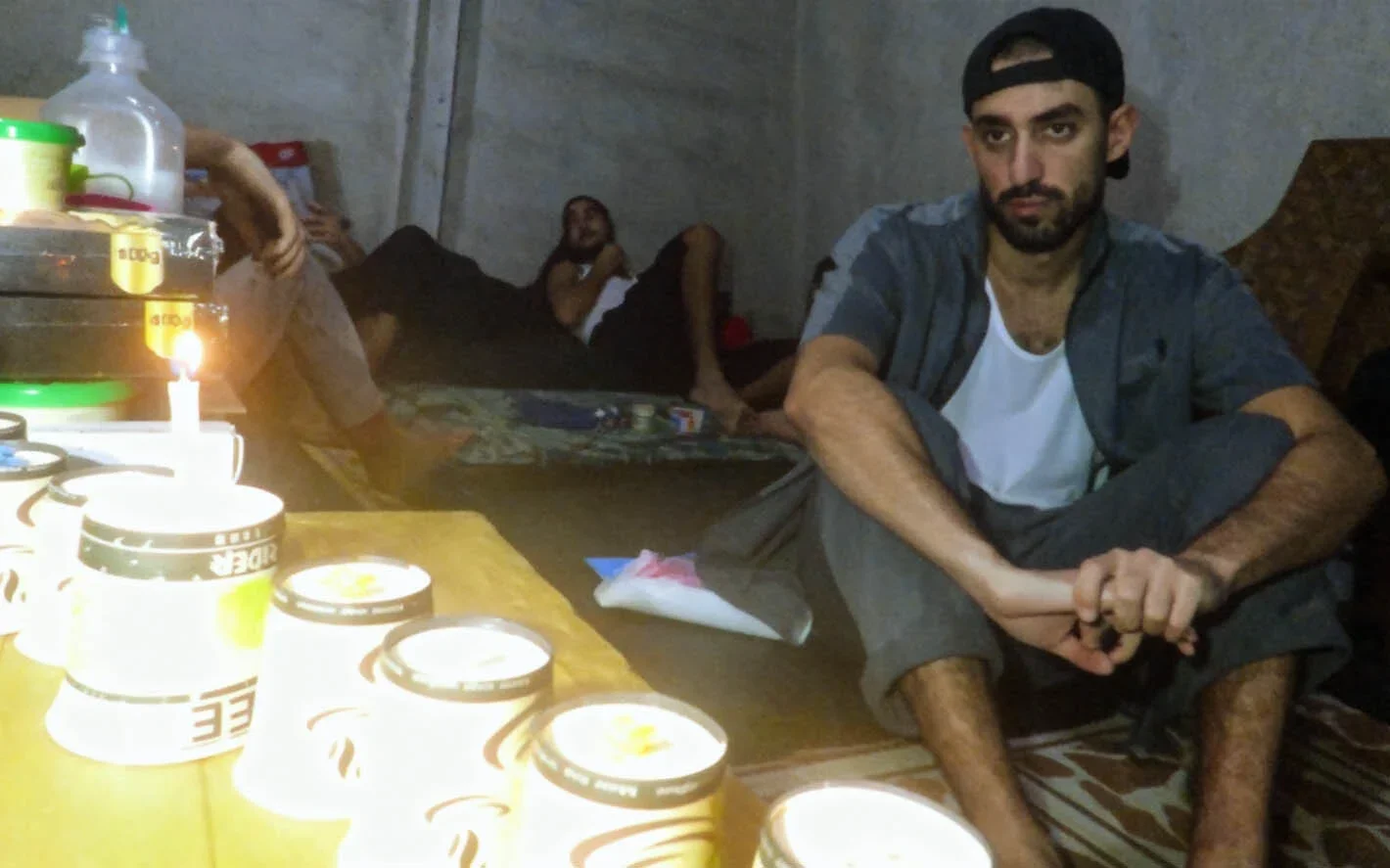
The Spark Within: The Story of Our Hostages
Matan Angrest, 22, was kidnapped by Hamas on October 7 from his tank near Nahal Oz after a fierce battle that left the rest of his crew dead. Despite suffering severe injuries and brutal torture, he described his experience as “a series of miracles.” Just weeks into captivity, Matan demanded a siddur, Chumash, and tefillin, and shockingly, his captors complied. “I prayed three times a day: morning, afternoon, and night,” he recalled. “It protected me; it gave me hope.”

Fake it till you make it
According to a recent study published in the journal Experimental Psychology, researchers found that smiling — even a fake smile — can have a positive impact on your mood.
Essentially, triggering certain facial muscles by smiling can “trick” your brain into thinking you're happy. When your muscles say you're happy, you're more likely to see the world around you in a positive way.

An Open Home
Have you ever registered for a free service only to learn later on about hidden costs or a requirement to upgrade to a premium package to fully benefit from the product?
In the context of subscription-based businesses, freemium is a business model where a company offers a version of its subscription service to all customers for free enabling them to help drive faster recurring revenue and profit growth than a paid-only model.

Social Conformity
In the 1950s, Solomon Asch, a young Jewish immigrant from Poland, conducted a series of psychological experiments to explore how strongly peer pressure influences the choices we make in our decisions and lifestyles. Known famously as the Asch Conformity Experiments, these studies revealed that nearly 75% of participants conformed to group opinions at least once, even when those opinions contradicted reality, illustrating a common willingness to disregard personal perception for group acceptance.

From Abraham to Amazon: The Power of Leaving Your Comfort Zone
In 1994, Jeff Bezos was just 30 years old and thriving as a senior vice president at D. E. Shaw, a prestigious Wall Street investment firm. He had what most people would consider a promising future: a secure, high-paying job, prestige, and a clear career path.
Then he encountered a statistic that changed everything: internet usage was growing at 2,300% per year. Bezos realized that this new medium could transform the world and that he could create something meaningful through it. He envisioned an online bookstore, a concept that didn't yet exist at scale.

Universal Mission
David Chase, a Holocaust survivor, businessman and philanthropist who led many important charitable efforts for Jewish communities around the globe, once shared an inspiring episode.Chase maintained the practice of praying in Tallit and Tefillin daily—even aboard airplanes and his personal yacht. In following the Talmudic dictum to face towards Jerusalem while praying, Chase regularly asked his captain, a non-Jew named Nick Winters, of the ship’s position and projected route.

Remaining Nonpartisan
During the turbulent early 20th century, Rabbi Yosef Yitzchak Schneersohn (1880–1950), known as the Previous Rebbe, was once traveling by train to Petersburg. In his car were noblemen, clergy, and a group of Jewish students. Before long, a heated discussion arose on the topic of ideal systems of government.

Finding Calm in the Current
Managing our stress level is a challenge we often face when trying to keep up with our daily responsibilities and commitments.
Maintaining a healthy balance between family, work, community and a connection to our heritage is essential to living a purposeful and meaningful life. But how can we properly dedicate ourselves to each of these aspects of our lives within the limited time we have without feeling overwhelmed? This quandary assumes even greater prominence during times like these when we are faced with uncertainty and unique challenges.

Lechaim- Are We Living or Existing?
“Lechaim (to Life)" is not just a nice slogan used when friends and family make a toast together during joyous occasions. Lechaim connotes a blessing and desire that we wish to focus more on living and less on just existing.
To exist means to consume space, resources, food and all other materialistic things that our physical existence depends on. To live, on the other hand, means to focus on the meaning and purpose of life. Instead of being motivated to work just to pay our bills, we strive to contribute to society, develop meaningful relationships with our families and friends, and make a positive difference for the people around us.

Speaking Truth to Power
As the world watched in great anticipation for the miraculous return of the hostages earlier this week on Hoshana Rabbah, the climax of the Sukkot holiday, a momentous gathering took place in the Israeli Knesset.
Standing before President Trump, Yair Lapid, of the centrist Yesh Atid party and the head of Israel’s opposition parties in government, declared:

Shared Merit, Shared Mission
When Sergey Brin and Larry Page met at Stanford University in 1995, they were two Jewish graduate students with strong, diverse opinions, curious minds, and a shared fascination with how to organize the rapidly expanding world of information on the internet. What began as an academic partnership soon evolved into one of the most transformative collaborations in modern history, the founding of Google.
They discovered that their differences were not obstacles, but strengths that complemented each other. Page’s vision, persistence, and product focus merged seamlessly with Brin’s mathematical insight, creativity, and restless curiosity. Together, they transformed a research project into a global tool that reshaped how humanity accesses knowledge.